IPS vs IAS vs Army Officer: Career Comparison for Students in Class 10 and 12
IPS vs IAS vs Army Officer: Career Comparison for Students in Class 10 and 12
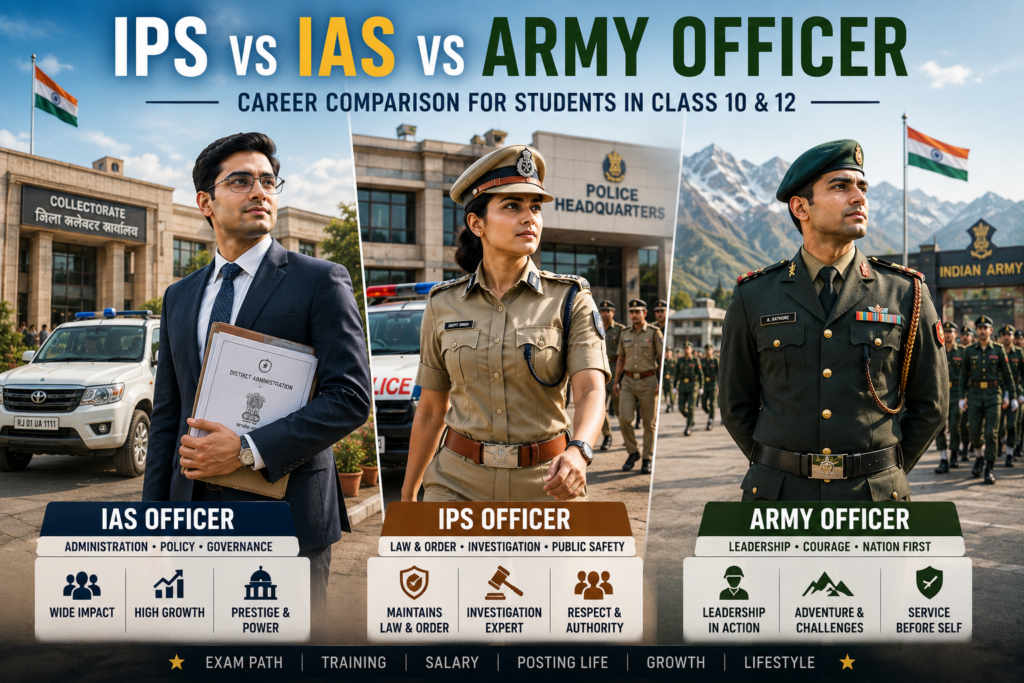
Three careers. Three uniforms. Three completely different lives.
And every year, we get the same question from students sitting across from us at Alpha NDA Academy: Sir, which one should I target? Army, IAS, or IPS?
Honest answer? Most students asking this have not actually looked at what each career involves. They know the names. They have seen the movies. But when it comes to the exam you need to clear, what your first posting looks like, what you will be doing on a Monday morning five years from now, or how your salary grows over 20 years that part is foggy.
This blog clears the fog.
We are going to compare all three careers on the same parameters. No filler, no vague inspiration. Real information that helps you decide.
The Full Picture at One Glance
Before we get into the detail, here is a table that puts all three side by side.
| What We Are Comparing | IAS Officer | IPS Officer | Army Officer (via NDA) |
| Full form | Indian Administrative Service | Indian Police Service | Indian Army (through National Defence Academy) |
| Exam to appear for | UPSC Civil Services Examination | UPSC Civil Services Examination | UPSC NDA Examination |
| Minimum qualification to apply | Graduation from any recognised university | Graduation from any recognised university | Class 12 pass or appearing (any stream for Army wing) |
| Age at which you can start | 21 to 32 years (General category) | 21 to 32 years (General category) | 16.5 to 19.5 years |
| Number of attempts allowed | 6 for General category | 6 for General category | No official limit, subject to age |
| Training location after selection | LBSNAA, Mussoorie | SVPNPA, Hyderabad | IMA, Dehradun (after NDA, Pune) |
| Starting basic pay | Rs. 56,100 per month | Rs. 56,100 per month | Rs. 56,100 per month plus MSP Rs. 15,500 |
| Total in-hand salary at entry | Rs. 80,000 to 1,50,000 per month (varies by city) | Rs. 67,000 to 71,000 per month (after deductions) | Rs. 90,000 to 1,00,000 per month (with allowances) |
| Entry-level rank | Sub-Divisional Officer or Assistant Collector | Deputy Superintendent of Police (DSP) | Lieutenant |
| Highest rank possible | Cabinet Secretary | Director General of Police (DGP) | General (Chief of Army Staff) |
| Highest pay at top rank | Rs. 2,50,000 per month | Rs. 2,25,000 per month | Rs. 2,50,000 per month |
| Uniform | No (formal attire at official events) | Yes (full uniform mandatory on national days) | Yes (always) |
| Physical fitness test required | No (basic health standards only) | Yes (height, weight, and physical standards for IPS) | Yes (strict physical and medical fitness) |
The Exam Path: Getting In Is Very Different for All Three
This is where the comparison starts before anything else, because the entry route for all three careers is completely different.
For IAS and IPS, the door is the same: UPSC Civil Services Examination. This is one of the toughest competitive exams in India. Around 10 lakh students apply every year. The exam has three stages: Prelims (objective), Mains (descriptive), and Interview. You need to have graduated from any recognised university in any subject before you can appear. Minimum age is 21 years.
The difference between IAS and IPS is not the exam it is your rank and your preference form. Both services are filled through the same CSE. If you get a higher rank and prefer IAS, you get IAS. If your rank places you lower, or you prefer police work, you may end up with IPS. General category candidates get 6 attempts up to age 32.
The Army officer path through NDA is a completely different track. You do not need a degree. You sit for the UPSC NDA examination right after Class 12, or even while you are still in Class 12. The age window is 16.5 to 19.5 years. After clearing the written exam, you go through a five-day SSB interview. If you are selected, you train at NDA in Pune for three years, then at IMA Dehradun for one year, and you are commissioned as a Lieutenant in the Indian Army.
What this means practically: If you are a student right now in Class 10 or 11 with a dream of a government career in uniform, the Army path lets you start earlier. The IAS and IPS paths require you to graduate first, which means at minimum a 5 to 6 year wait after Class 12. Many students clear the IAS or IPS exam in their mid to late 20s.
Training: Three Very Different Starts
Once you are selected, each career puts you through a different kind of training that shapes who you become as an officer.
IAS training happens at the Lal Bahadur Shastri National Academy of Administration in Mussoorie. It is approximately two years of training that covers public administration, law, economics, policy, and governance. Trainees go on district visits, study actual government schemes, and learn the administrative machinery of India from the inside. The top performing IAS trainee during this program receives the President’s Gold Medal.
IPS training is at the Sardar Vallabhbhai Patel National Police Academy in Hyderabad, and it runs for about two and a half years. The training is more physically intensive compared to IAS and covers criminal law, forensics, weapon handling, horse riding, and counter-terrorism. The top performing IPS trainee receives the Prime Minister’s Baton.
Army officer training begins at NDA in Khadakwasla, Pune, where you spend three years with cadets from the Navy and Air Force too. Then comes one year at IMA Dehradun. Total training is about four years. The physical intensity of Army training is in a different league altogether. Early morning parades, weapons drill, obstacle courses, tactics, map reading, and leadership exercises define daily life. By the time you are commissioned, you have lived in a highly disciplined environment for four years before you even see your first posting.
One thing we tell students at Alpha NDA Academy: the lifestyle you experience during Army training is actually what Army life looks like on posting too. There is no big shift between training and service. IAS and IPS training prepares you for a desk and field administration role, and the job itself reflects that.
What Your Job Actually Looks Like Day to Day
This is the comparison that matters most, and the one most students never research.
An IAS officer, especially in the early years, is typically posted as a Sub-Divisional Officer or Assistant Collector in a district. You handle land revenue, oversee government schemes like housing, healthcare, and rural development, coordinate between departments, manage elections, and are the primary person responsible for district administration during floods, droughts, or any other crisis. As a District Magistrate, you are legally the senior-most authority in a district. You supervise the Superintendent of Police, which means an IAS officer in many contexts holds authority over an IPS officer of equivalent seniority.
The IAS career involves working inside government systems, interfacing with politicians and bureaucrats, writing policy notes, reviewing project reports, and coordinating with multiple agencies. It demands strong writing skills, patience with processes, and an ability to work within a system. The impact is wide: a good District Magistrate can change the lives of lakhs of people.
An IPS officer, typically starting as a Deputy Superintendent of Police, works in law enforcement. You manage police stations in your jurisdiction, investigate crimes, maintain public order during elections, festivals, and protests, and coordinate anti-crime operations. Senior IPS officers head agencies like the CBI, Intelligence Bureau, and Research and Analysis Wing. They also lead state police forces as Director General of Police. IPS is a more field-oriented, publicly visible career compared to IAS. It demands physical fitness and comfort while working under pressure and unpredictable situations.
An Army officer’s job is the most physically demanding of the three. As a Lieutenant, you are leading a platoon of around 30 soldiers. Your job is to train them, take care of their welfare, and be ready to lead them in operations when called. Postings range from border areas in Ladakh or Arunachal to counter-insurgency zones in Jammu and Kashmir to peacetime stations in cities. The Army also participates in UN peacekeeping missions and disaster relief. Unlike the IAS and IPS, your work is not behind a desk. You are physically present with your men at all times.
Posting Life and How It Shapes Your Lifestyle
This is something students almost never think about, and something every experienced officer will tell you matters enormously.
IAS officers can request postings or get assigned cadres based on merit at the time of joining. Once your cadre is decided, you typically serve in that state and its districts throughout your career, with some stints on central deputation in Delhi. Postings change every few years. You may find yourself in a small district one year and heading a state department the next. The lifestyle varies a lot depending on whether you are in a city posting or a rural one.
IPS officers similarly serve in their allotted cadres. They can be posted in districts, state headquarters, or central agencies. Senior IPS officers posted to the Intelligence Bureau or RAW or CBI have a very different lifestyle from a Superintendent of Police managing a rural district. The job comes with odd hours, no fixed shifts, and the possibility of being called at any time during a law and order situation.
Army officers rotate postings every two to three years and move across the country. You could be in Rajasthan’s desert region on one posting and in a Northeast jungle posting the next. Some postings are in well-developed cantonment areas where family can join you. Field postings, particularly on active borders, involve separation from family for extended periods. Army cantonments are generally clean, self-contained communities with schools, hospitals, and sports facilities.
A practical point for students from Rajasthan, UP, Haryana, or smaller towns who ask us this: the Army is often the only career among these three that takes you to a full lifestyle system from Day 1, with accommodation, food, and facilities provided on campus throughout training and service. You do not need to figure out housing in a new city as a new recruit.
Salary: Where the Three Careers Actually Differ
All three careers start at the same basic pay of Rs. 56,100 per month as per the 7th Pay Commission at Pay Level 10. But the in-hand amount and growth path differ.
| Rank Stage | IAS Officer | IPS Officer | Army Officer |
| Entry level | Rs. 80,000 to 1,50,000 per month in-hand (city-dependent) | Rs. 67,000 to 71,000 per month in-hand | Rs. 90,000 to 1,00,000 per month in-hand |
| Mid career (10 years) | Basic pay around Rs. 1,44,200 (Pay Level 14) | SP or DIG level | Major to Lieutenant Colonel level |
| Top rank | Rs. 2,50,000 per month (Cabinet Secretary) | Rs. 2,25,000 per month (DGP) | Rs. 2,50,000 per month (General, COAS) |
The Army officer gets Military Service Pay of Rs. 15,500 per month on top of basic pay, from Lieutenant up to Brigadier. This is why Army in-hand salary at entry typically runs higher than IPS in-hand at the same Pay Level. Army officers in field postings get Field Area Allowance. High-altitude posting officers get High Altitude Allowance. Both add meaningfully to monthly income.
IAS officers can earn more than both in certain senior roles, particularly when on central deputation with additional charge allowances. But the IPS officer typically earns slightly less than both at the highest rank because the DGP pay tops at Rs. 2,25,000, while Cabinet Secretary (IAS) and General (Army) both reach Rs. 2,50,000.
Beyond salary, all three careers come with substantial perks. Government housing, official vehicles, free medical treatment for self and family, and pension benefits after retirement are standard across all three. Army officers also get access to subsidised canteen facilities and the Army Wives Welfare Association support system.
Career Growth: How High You Can Go and How Fast
The speed of career growth is one of the most practically important differences between the three, and one that is rarely discussed honestly.
IAS and IPS officers progress through seniority and performance assessments. A common point of debate is that IPS officers reach the DIG rank roughly 8 to 10 years earlier than an Army Brigadier of equivalent seniority reaches his rank, because civil services promotions work on a different timeline from the military. The Army promotion system is more seniority-based, and vacancies at higher ranks are fewer.
For IAS, the rank progression runs from Sub-Divisional Officer up through District Magistrate, Divisional Commissioner, Secretary to State Government, Joint Secretary at the Centre, Secretary, and ultimately Cabinet Secretary, which is the highest bureaucratic position in India. There is exactly one Cabinet Secretary at any given time.
For IPS, the progression goes from DSP to SP to DIG to IG to Additional DGP to DGP. Senior IPS officers also hold positions as heads of CBI, IB, and national security agencies.
For the Army, progression after commissioning as a Lieutenant runs through Captain, Major, Lieutenant Colonel, Colonel, Brigadier, Major General, Lieutenant General, and finally General. The Army also has positions outside the rank ladder, such as Army Commander and finally Chief of Army Staff.
One practical reality: most Army officers retire at the rank of Colonel or Brigadier. Reaching Major General or above requires both outstanding performance and the right timing in terms of vacancies. The same is true in IAS and IPS. Very few officers in any of these three services reach the apex rank.
Which Career Is Actually Right for You?
We have this conversation with students every week. Here is the honest version of what we say.
If you want to be part of governance, shape policy, and work across education, health, infrastructure, and rural development, and you are comfortable spending your career largely within bureaucratic systems, IAS is the most powerful administrative career available in India. You will need a degree first, and you will need to compete against lakhs of students for a small number of seats. It takes patience and typically several years of dedicated preparation after graduation.
If law enforcement excites you, if you want to lead police forces, investigate crimes, work in intelligence, and hold public-facing authority over security, IPS is the right path. It comes through the same exam as IAS, but the work culture and daily life are very different. You need the same academic preparation but also physical fitness that meets IPS standards.
If you want to start serving early, live a life of physical challenge and direct command, lead soldiers in the field, and do not want to wait until your late 20s to begin your career in uniform, the Army path through NDA is your best option. You can start at 16 and a half years of age. You do not need a degree to begin. You earn while you train. And by the time your peers who chose IAS finish their graduation and start UPSC preparation, you may already be a Captain with three years of commissioned service behind you.
There is no answer to which career is best. They are simply different. The Army gives you early start, physical life, direct leadership, and field posting variety. The IAS gives you widest administrative reach and governance power. The IPS sits between the two in terms of field orientation and institutional authority.
What we always tell students is this: think about what your daily life looks like five years after you join, not just how the career sounds at a dinner table.
A Note If You Are Targeting the Army Path
If the Army path interests you, the time to start preparing is right now, while you are in Class 10 or Class 11. The NDA exam tests Mathematics, English, Physics, Chemistry, General Science, History, Geography, and Current Affairs. The SSB after that tests your personality, decision-making, leadership potential, and communication.
This is exactly what we prepare students for at Alpha NDA Academy in Sikar, Rajasthan.
Our ARJUNA Batch is for students after Class 10 who want to build NDA foundations alongside their Class 11 and 12 studies. The BULLS EYE Batch combines NDA preparation with Class 12 for students currently in school. Our SPARTANS Batch is one year of intensive preparation for students who have completed Class 12. For girls, we have a dedicated batch with a separate hostel, women mentors, and full NDA and SSB preparation.
We also run the STRIKE Batch for students targeting Air Force and Navy wings specifically.
Our 90 percent written selection rate and SSB recommendation for every third student come from 14 plus hours of daily mentorship, weekly UPSC-level mock tests on full 900 marks, SSB preparation from Day 1, and one of the best GTO grounds in India right on our campus.
If you want to read about the NDA exam structure, what subjects are tested, and how to plan your preparation, read our detailed guide here: NDA Exam Syllabus 2026
To talk to one of our mentors directly, call 7240040400 or message us on WhatsApp.
Common Questions Students Ask Us About This Comparison
Can a student in Class 12 directly apply for IAS?
– No. IAS and IPS both require a graduation degree from a recognised university as the minimum educational qualification. You also need to be at least 21 years old to appear for UPSC CSE. The only UPSC exam open directly after Class 12 is the NDA examination, which is for Army, Navy, and Air Force.
Which career has the most power?
– It depends on context. In district administration, an IAS officer as District Magistrate holds authority over all departments, including the police. An IPS officer leads law enforcement and can head national agencies like CBI and IB. An Army officer commands operational authority in military matters and holds supreme power in conflict zones or under special laws. None of the three is simply more powerful than the others; they operate in different domains.
Which career is most respected in Indian society?
– Honestly, all three carry enormous respect in India. Among 10th and 12th standard students specifically, Army officers often hold the highest public respect at the local level, particularly in states like Rajasthan, Haryana, UP, and Punjab where defence culture is strong. IAS and IPS are seen as peak government careers by students aiming for UPSC.
Can I switch from Army to IAS or IPS later in life?
– Yes, but it requires you to leave the Army, complete your graduation (Army provides degree through NDA training), and then appear for UPSC CSE. Many Army officers have gone on to clear IAS and IPS exams after their service. The discipline and preparation mindset from Army training actually helps in UPSC preparation.
How many students clear UPSC CSE each year for IAS and IPS combined?
– Around 10 lakh students apply for UPSC CSE annually. Roughly 900 to 1,000 candidates are finally recommended across all civil services combined, including IAS, IPS, and others. IAS seats are around 80 to 100 per year, and IPS is around 150 to 200, depending on the year’s notification.
Is the NDA written exam harder than UPSC CSE?
– They are different in nature. UPSC CSE is longer, more comprehensive, and requires years of dedicated preparation at graduation level. NDA is a Class 12 level exam focused on Mathematics and General Ability, and it requires structured coaching and consistent effort over one to two years. Neither is easy. Both are competitive. NDA has approximately 5 lakh applicants for around 400 seats per exam.
Before You Decide
These three careers represent three very different relationships with public service.
One puts you behind a desk shaping policy for millions. One puts you in front of a district with a lathi and a badge. One puts you at the front of a platoon with a rifle and 30 men depending on you.
Spend time thinking about which relationship with work you actually want. Talk to officers in each service if you can. Read about the daily realities, not just the rank and salary.
And if the Army path is where you are leaning, start today. The NDA window is young. Once you are past 19.5 years of age, that door closes.
We are here if you want to talk through it.
alphandaacademy.in | Call: 7240040400 | WhatsApp