Life at NDA Khadakwasla What Cadets Actually Experience
Life at NDA Khadakwasla What Cadets Actually Experience
Every student who walks into our classroom at Alpha NDA Academy has a version of NDA in their head.
Some imagine it from movies. Some have heard stories from relatives who served. Some have pieced it together from YouTube videos, forum posts, and old photographs of cadets in khaki.
But very few have a truly accurate picture of what it is actually like to live at the National Defence Academy in Khadakwasla.
And that gap between what they imagine and what NDA actually is that gap matters. Because the clearer you are about what you are working toward, the more honestly and seriously you prepare for it.
This blog is our attempt to close that gap.
Over the years at Alpha NDA Academy, we have stayed connected with alumni, spoken to cadets and officers, and built a picture of NDA life that goes beyond the polished photographs of Passing Out Parades. We are going to walk you through what life at NDA Khadakwasla actually looks like from the first morning you arrive to the day you march out in your final parade.
If you are a student in Class 10, 11, or 12 with your sights set on NDA, read every section of this article. What you read here is what you are working toward.
What Is the National Defence Academy The Foundation You Need to Know
Before we go inside the campus, let us make sure you understand what NDA actually is, because many students only have a partial picture.
The National Defence Academy in Khadakwasla, Pune, is not a school. It is not a university. And it is not a regular military base.
It is the joint defence academy of the Indian Armed Forces the first tri-service academy in the world where cadets of the Indian Army, the Indian Navy, and the Indian Air Force train together before proceeding to their respective service academies for further pre-commission training.
Let that fact sit for a moment. The first tri-service academy in the world. Army, Navy, and Air Force cadets train side by side, living together, eating together, competing together. That is the NDA.
The campus is located about 17 kilometres southwest of Pune city, northwest of Khadakwasla Lake, with the Sinhagad Fort providing a panoramic backdrop. It spans 7,015 acres of land and an enormous campus with its own lake, airstrip, sports fields, academic blocks, obstacle courses, and squadron buildings.
The foundation stone was laid by Prime Minister Jawaharlal Nehru on 6 October 1949. NDA was formally commissioned on 7 December 1954, with an inauguration ceremony held on 16 January 1955.
Its motto is “Service Before Self.” Every cadet lives by those three words for three years.
Academically, NDA is affiliated to Jawaharlal Nehru University (JNU), Delhi. Cadets graduate with a Bachelor of Arts, Bachelor of Science, or Bachelor of Computer Science degree on completion of the three-year course.
NDA alumni include 3 Param Vir Chakra recipients and 13 Ashoka Chakra recipients. NDA has also produced 32 service chiefs of staff to date. These are the officers who eventually led the Indian Army, Navy, and Air Force. They all passed through the same campus, the same squadrons, the same parade ground that today’s cadets walk.
This is what you are preparing to become a part of.
The First Day What Actually Happens When You Arrive
After clearing the NDA written exam, SSB interview, and medical examination, selected cadets receive joining instructions from NDA Headquarters. They report to Khadakwasla on the specified date.
Nothing prepares you entirely for that first day.
You come as a civilian. You have passed one of the most competitive exams in India. You have cleared a five-day personality assessment that most people do not get through. You feel accomplished.
And then you arrive at NDA and you realise that everything you have achieved until this point was just the entry ticket. The real journey starts now.
On arrival, cadets go through documentation, medical re-verification, and a formal orientation to understand the academy’s rules, discipline structure, and training schedule. You are issued your uniform, equipment, and room assignment.
Your khaki uniform is the standard dress colour for all NDA cadets, chosen specifically to create homogeneity across all three services and all backgrounds.
And then you are assigned to your squadron.
The Squadron System Your Family for Three Years
There are 18 Squadrons at NDA named Alpha, Bravo, Charlie, Delta, Echo, Foxtrot, Golf, Hunter, India, Juliet, Kilo, Lima, Mike, November, Oscar, Panther, Quebec, and Romeo. These 18 squadrons are divided into five battalions.
A cadet belongs to their squadron for the full 3 years. The squadron is their family; they eat together, compete together, and are judged together.
Each squadron has approximately 100 to 120 cadets drawn from senior and junior courses at all stages of training. So when you join as a first-termer, you are living alongside cadets who are in their fifth or sixth term. This is deliberate. The senior-junior dynamic is central to how NDA shapes leaders.
Each squadron has its own nickname, an individual identity with a richly textured history and mascot. The motto of NDA “Service Before Self” is first taught in the environs of the squadron, where a cadet learns the importance of putting the squadron’s requirements well above his own.
There is also a prestigious Inter Squadron Championship Trophy, which is awarded to the best Squadron, and the one who wins it has the proud tradition of possession of the Champion banner for one term, which is carried during the parade and other sports meets.
The Best Squadron Trophy is everything at NDA. It is the culmination of academic performance, sports results, parade quality, mess standards, and overall discipline across an entire term. Winning it is a matter of immense pride for the squadron and for every cadet in it.
This is where the NDA spirit is born. Not in individual achievement, but in collective excellence.
The Orientation Capsule The First Two Months Nobody Warns You About
New cadets are welcomed to NDA by the Joint Training Team (JTT). Before regular training begins, all new cadets go through what is called the Orientation Capsule, a two-month intensive phase designed to break civilian habits and build military foundations.
This is also commonly referred to as PT Zero.
It is intense. Purposefully so.
By the end of PT Zero, most cadets have lost 3 to 5 kg, gained real fitness, and begun forming the bonds that last a lifetime.
The Orientation Capsule involves a blend of indoor and outdoor training. Indoor training covers theoretical and practical military knowledge. Outdoor training is conducted in the hilly and dense terrain around the NDA campus.
Throughout this period, cadets face consistent pressure from seniors, instructors, and officers. The expectations are uncompromising. The standards are set high immediately. There is no easing in. There is no adjustment period of weeks and weeks.
This is the phase where NDA decides whether you are genuinely ready to be reshaped. Most cadets find it harder than they expected. Most also say it was the most important phase of their entire NDA training.
When it ends, a cadet is different from the person who arrived.
A Complete Day in the Life of an NDA Cadet
Life at NDA is rigidly structured. Every hour is accounted for. No exceptions.
Here is what a typical day actually looks like.
4:30 AM Reveille
The day begins before sunrise. The bugle sounds. Cadets are up immediately. There is no snooze. There is no five minutes. The moment the reveille sounds, you are on your feet.
Personal hygiene is done quickly. Uniforms are put on. And within minutes, cadets assemble.
5:00 to 6:30 AM Morning Physical Training
The morning PT session is the foundation of every day at NDA.
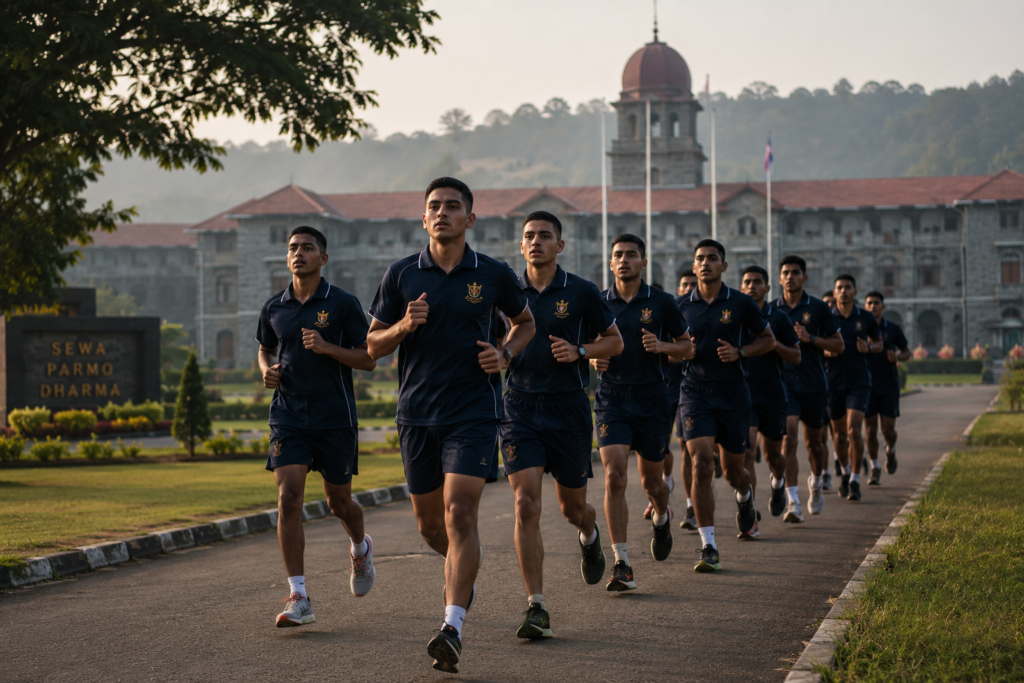
Endurance runs. Push-ups. Sit-ups. Stretching. Progressive physical conditioning that gets harder as terms progress. Not everyone runs the same distance in the first term as they do in the sixth term. The training builds over three years.
This session does not just build physical fitness. It builds the ability to perform under fatigue which is exactly what military life requires. The rigorous PT session ensures that cadets develop mental toughness and a high level of fitness, essential for military life.
6:30 to 7:30 AM Drill Session
After PT, cadets move to the parade ground for drill.
The drill is an essential part of military training, focusing on synchronisation, coordination, and discipline. Under the watchful eyes of their instructors, cadets practise various parade formations and marching drills, instilling a sense of pride and unity.
NDA cadets are known for executing some of the most precise and disciplined parade drills in India. That precision is built one morning at a time over three years.
7:30 to 8:30 AM Breakfast
Cadets proceed to their squadron mess for breakfast.
The food at NDA is plentiful by design. Cadets burn enormous amounts of energy every day and the kitchen caters accordingly. Breakfast typically includes items like poha, upma, eggs, bread, fruit, and tea or milk.
Each squadron has its own mess. Inter-mess food competition is taken seriously the Best Mess Trophy is contested annually.
Mealtime is also one of the few moments when the pace slows slightly and bonds between cadets are built informally.
9:00 AM to 1:00 PM Academic Classes
This is a part of NDA that surprises many new cadets and many parents.
Despite being a military academy, academic standards at NDA are serious. Cadets pursue a B.Sc or B.A. degree from JNU.
Academic classes cover a rigorous curriculum. Science stream cadets study Physics, Chemistry, Mathematics, and Computer Science. Humanities stream cadets study History, Political Science, Economics, and Geography. All cadets study military subjects including military law, weapon handling, map reading, and the history of military campaigns and operations.
Academic periods are taught by civilian professors (NDA has its own academic faculty) and military instructors. The standard is genuine, not watered down.
Examinations are held every term. Cadets who fail academically are placed on academic probation. Persistent failure leads to relegation (repeating a term) or in extreme cases, exit from NDA.
This is not a place where you can coast through academically while focusing only on physical training. Both are required. Both are non-negotiable.
1:00 to 2:30 PM Lunch and Brief Rest
After the morning of academics, cadets head to the mess for lunch. The meal is designed to replenish energy for the afternoon ahead.
There is a brief rest period after lunch. But this is shorter than most civilians imagine. The NDA day does not pause for long.
3:00 to 6:00 PM Sports, Games, and Military Training
The afternoons are dedicated to physical training, sports, and military training. Cadets participate in various sports like football, basketball, hockey, and swimming, fostering team spirit and physical agility.
Every NDA cadet is required to play at least one sport competitively. The options are wide: football, hockey, basketball, volleyball, boxing, wrestling, judo, karate, squash, tennis, swimming, rowing, sailing, and horse riding.
Swimming is compulsory for all cadets who cannot swim learn at NDA. Equitation (horse riding) is compulsory for Army cadets.
Military training in the afternoon includes weapon handling, obstacle courses, map reading, tactical exercises, field craft, and leadership exercises where cadets rotate through command positions.
The afternoon is physically demanding. But it is also where many of the deepest bonds between cadets are formed in the heat of competition, in the shared exhaustion of a difficult obstacle course, in the quiet moment after a long run when you realise the person next to you pushed through it the same way you did.
6:00 to 7:00 PM Freshen Up and Transition
Cadets return, clean up, and transition to the evening schedule.
7:00 to 9:00 PM Evening Study and Personal Time
This is the self-study and academic revision period. Cadets review the day’s lessons, complete assignments, and prepare for upcoming term examinations.
Senior cadets often use this time to mentor juniors. The NDA learning environment is not purely formal. Much of the most valuable learning happens between cadets of different terms.
9:00 PM Dinner and Wind Down
Dinner is served. It is a moment to reflect on the day and prepare mentally for tomorrow.
10:00 PM Lights Out
By 10 PM, the day ends. Cadets sleep. The bugle will sound again at 4:30 AM.
Every single day. For three years.
Academic Life at NDA Harder Than Most Expect
We want to spend a little more time on academics because this is where the popular image of NDA diverges most sharply from reality.
Many students assume NDA is primarily a physical training institution where academics are secondary. This is completely wrong.
The NDA curriculum affiliated to JNU is a genuine university degree programme. The academic faculty includes qualified civilian professors who teach at university standards. Military instructors add the service-specific dimension.
What makes NDA academics unique is the combination of pressure they exist within. A cadet is simultaneously managing physical exhaustion from daily PT, the demands of squadron life and sports, the emotional intensity of a hierarchical military environment and still expected to perform academically at a level that earns a JNU degree.
This is exactly the kind of multi-pressure environment that builds the thinking, problem-solving officer that the armed forces need.
For students who ask us at Alpha NDA Academy whether the NDA syllabus is connected to what they study in school, the answer is yes. The NDA provides a well-structured curriculum covering subjects like Mathematics, Physics, History, Political Science, and Military Studies. The aim is to develop intellectual capability and decision-making skills.
The foundation built in Class 11 and 12 is what carries you into NDA academics. Students who are genuinely strong in these subjects find the academic adjustment smoother.
To understand what the NDA written exam covers: NDA Exam Syllabus 2026 Complete Guide
Physical Training at NDA What Cadets Actually Go Through
Physical excellence is not a goal at NDA. It is the baseline expectation.
Every cadet takes periodic Physical Efficiency Tests (PET). These tests are not optional or advisory. Failing PET has serious consequences: remedial PT, restricted privileges.
The physical training at NDA is progressive. First-term cadets begin at a level that is already demanding by any civilian standard. By the sixth term, the level of fitness, endurance, and physical capability that cadets carry is extraordinary.
Long runs with full battle load. Obstacle courses. Cross-country events. Swimming sessions. Horse riding. These are not activities that cadets choose to do. These are requirements, structured into the timetable, governed by performance standards.
The physical transformation at NDA is one of the most consistent things alumni describe when they speak about their time there. A cadet who spent three years at NDA does not just look different. They move differently, carry themselves differently, and have a physical capacity that stays with them for decades.
The Unique Experiences You Will Not Get Anywhere Else
This is the part of NDA life that genuinely shocks most students when they first hear about it.
Gliding
Every NDA cadet learns to fly a glider.
A gliderdrome having a runway is maintained within the premises of the NDA by the AFTT. The Air Force cadets of the academy learn the basics of gliding and powered flight at this facility on the Diamond HK36 Super Dimona gliders.
Cadets cleared for solo flying fly one solo trip on the glider and are then formally awarded their Wings exactly half the size of the official Indian Air Force wings worn above the left shirt pocket of their formal uniforms.
The cadet who went solo with the lowest number of launches was usually awarded the Best In Gliding Trophy on the Guest Dining-in Night, one night prior to the Passing Out Parade.
Think about that. An 18-year-old cadet from a small town in Rajasthan or Bihar, who had never been in a cockpit before, flying a glider solo over the Khadakwasla terrain.
That experience changes a person.
Horse Riding
Equitation, or horse riding, is a compulsory part of Army cadet training at NDA. Learning to handle, ride, and care for a horse requires patience, precision, and the kind of quiet confidence that physical strength alone cannot build. It is one of the disciplines that NDA has maintained through its decades of tradition.
Adventure and Outdoor Activities
The hills and terrain around NDA campus become a training ground for trekking, rock climbing, and navigation exercises. Cadets learn to operate and navigate in outdoor environments that are genuinely challenging, not simulated.
This adventure training is not just about physical capability. It is about resourcefulness, decision-making, and staying calm when the environment is not comfortable.
Field Craft and Tactical Training
Cadets learn camouflage, patrolling, ambush techniques, and survival skills. Weapon handling and map reading are formal parts of the curriculum. Leadership exercises involve cadets rotating through command positions in training scenarios practising giving orders, making decisions under pressure, and handling the responsibility of leading people.
Service-Specific Training Where the Three Paths Begin to Separate
For the first five terms, all cadets undergo largely common training. This is the beauty of the NDA model Army, Navy, and Air Force cadets share the same academic periods, the same parade ground, the same sports facilities, and the same squadron mess.
It is only in the later terms that the paths begin to diverge.
Army cadets study some special tactics in the sixth term. The Naval Training Team (NTT) trains naval cadets at Watermanship Training Centre (WTC) in the sixth term covering navigation, seamanship, and ship handling. The Air Force Training Team (AFTT) is in charge of the Air Force specific training and flying training commences in the sixth semester.
This service-specific phase gives cadets their first deep exposure to the specific demands of their respective armed forces. An Army cadet begins to think and train as an infantry officer will. A Navy cadet gets close to the water, to navigation, to the demands of seamanship. An Air Force cadet begins to understand the sky and in some cases begins to fly.
The Hierarchy How Seniors and Juniors Actually Relate
The seniority system at NDA is one of the most discussed and least understood aspects of cadet life.
NDA has a strict hierarchy based on term (semester). Senior cadets hold positions of responsibility Under Officer (UO), Senior Under Officer (SUO). The Senior Under Officer of the best squadron is effectively the most prestigious non-commissioned position among cadets.
The relationship between senior and junior cadets is intense and formative. Seniors are responsible for the discipline, training, and development of juniors in their squadron. Juniors look to seniors for guidance, standards, and the lived example of what a more experienced cadet looks and acts like.
This is very different from any school or college environment. The senior here is not just an older student. The senior carries real responsibility and real authority. And the junior is expected to respond to that authority with genuine respect, not just compliance.
Over three years, a cadet moves from being the newest, least experienced member of a squadron to being someone who carries that very responsibility for the cadets coming after them. That full arc from junior to senior, from follower to leader is one of the most powerful development experiences NDA provides.
Clubs, Events, and Cultural Life at NDA
NDA is not only physical training, academics, and hierarchy. There is a rich cultural and intellectual life woven through the three years.
Cadets are encouraged to join clubs where they can learn new things. Debates, public speaking competitions, seminars, and interactions with civil institutes are regularly organised.
Outdoor clubs include trekking, rock climbing, water sports, and various adventure activities that develop teamwork, endurance, and outdoor competency beyond what the formal training schedule covers.
Indoor clubs explore arts, music, literature, and public speaking. These are not soft options. They are a serious part of the NDA’s commitment to developing rounded, articulate, cultured officers who can communicate across contexts, think creatively, and connect with people beyond their immediate military environment.
Cross-country runs, boxing championships, athletics meets, and inter-squadron competitions fill the calendar across every term. The competitive spirit at NDA is constant and fierce but it is always channelled toward collective achievement rather than individual glory.
Over 700 cadets from 27 countries train alongside their Indian counterparts at the NDA. This means the cultural exposure at NDA extends internationally. Cadets build relationships with peers from friendly foreign nations, developing a global perspective on defence and service that very few institutions in India can offer.
What the Food Experience Is Really Like
People ask us about food at NDA more than you might expect. Students are young, training hard, and genuinely worried about whether they will eat well.
The honest answer is that food at NDA is taken seriously and is genuinely good.
Cadets burn enormous amounts of energy every day. A cadet in active NDA training can burn well over 3000 to 4000 calories on a physically demanding day. The mess system is designed to meet those needs.
Breakfast includes items like poha, upma, eggs, bread, butter, fruit, tea, and milk. Lunch involves dal, sabzi, rice, roti, curd, and seasonal vegetables. Dinner follows a similar structure with variations.
Each squadron has its own mess, and the competition for the Best Mess Trophy means that squadron kitchens take quality seriously. Food in NDA is not gourmet. But it is nutritious, sufficient, and often genuinely appreciated by cadets after a hard morning of PT and classes.
The Transformation What Three Years at NDA Actually Does
This is the section that matters most for every student reading this.
You can understand the daily schedule. You can know the subject list. You can visualise gliding and horse riding. But the real story of NDA is what three years there does to a person.
NDA is not just a school it is a transformation. Cadets enter as boys and girls. They leave as officers.
After three years at NDA, a cadet is physically among the fittest people in India. They have led teams under pressure more times than most people do in an entire lifetime. They have competed at the highest level in their academic subjects while simultaneously managing physical training, squadron responsibilities, and military demands. They have learned to function on limited sleep, to perform under pressure, to make decisions when the situation is not comfortable, and to take responsibility for people who depend on them.
The network of course-mates and squadron brothers and sisters becomes a family for life. The bond among NDA alumni and the NDA spirit is real and lifelong.
And then there is the alumni record.
NDA has produced 32 service chiefs of staff. When Lieutenant General Manoj Mukund Naravane got promoted to Chief of Army Staff in 2019, the chiefs of all three services Army, Navy, and Air Force were all NDA alumni from the same 61st course.
Three service chiefs. Same NDA course. Same campus. Same parade ground.
That is not a coincidence. That is what NDA does.
The Passing Out Parade The Grand Finale of Three Years
At the end of six terms, NDA cadets participate in the Passing Out Parade (POP). This is one of the most spectacular military ceremonies in India.
The unique parade held at the Khetarpal Parade Ground comprises over one thousand participating cadets bidding farewell to their senior colleagues.
The parade ground is named after 2nd Lt Arun Khetarpal, PVC, one of India’s greatest war heroes, who sacrificed his life during the 1971 war. Marching on the ground that bears his name, in front of thousands of spectators including parents, dignitaries, and senior officers, is a moment that cadets describe as unlike anything else.
The night before the POP is the Guest Dining-in Night, a formal dinner tradition where cadets dine together one final time as a course, celebrating the journey they have shared.
After the POP, cadets leave Khadakwasla and proceed to their respective service academies for one year of pre-commission training.
Where NDA Cadets Go After Khadakwasla
After three years at NDA and the Passing Out Parade, cadets move to their respective service academies:
Army cadets proceed to the Indian Military Academy (IMA) in Dehradun, Uttarakhand for a one-year pre-commission training programme. They are commissioned as Second Lieutenants in the Indian Army upon completion.
Air Force cadets proceed to the Air Force Academy (AFA) in Dundigal, Hyderabad for flying and ground training before receiving their commission as Flying Officers in the Indian Air Force.
Naval cadets proceed to the Indian Naval Academy (INA) in Ezhimala, Kerala for specialised naval training before being commissioned as Sub-Lieutenants in the Indian Navy.
One more year. And then the uniform. And then the commission. And then the career that started with an NDA written exam answer sheet is fully realised.
What This Means for You Right Now
If you have read this far, there is a reason. Something about this vision resonates with you.
Maybe you are in Class 10 right now, just beginning to understand what NDA is. Maybe you are in Class 11 and just starting your preparation. Maybe you are in Class 12 and your first NDA exam is months away.
Here is what all of this life at NDA means for you at your current stage.
Every quality that NDA builds discipline, physical fitness, academic ability, leadership instinct, the ability to perform under pressure those qualities do not appear on Day 1 at Khadakwasla. They are built over months and years of consistent, daily effort before a cadet even sets foot on that campus.
The students who thrive at NDA are the ones who started building those habits long before they arrived.
The student who wakes up at 5 AM for PT now will not be shocked by 4:30 AM reveille at NDA. The student who reads newspapers seriously now will handle current affairs and group discussion at SSB without stress. The student who studies consistently without needing to be pushed will manage NDA’s demanding academic schedule with confidence.
Your preparation today is not just for the written exam. It is for the life that comes after.
To understand what you are working toward fully: NDA Selection Process From Exam to Joining
To understand what happens right after the written exam: What Happens After NDA Written Exam
For a structured plan to build toward this: NDA Study Plan for 6 Months
For the habits you should start building today: 15 Good Habits Every NDA Aspirant Must Have
How Alpha NDA Academy Prepares Students for the Life That Awaits at Khadakwasla
At Alpha NDA Academy, our preparation goes beyond what the NDA written exam asks. We prepare students for the complete journey including the kind of person they need to be when they walk through the gates of NDA Khadakwasla.
That means physical training is part of our daily routine, not occasional. We build the fitness habits that help cadets survive and thrive in the demanding physical environment of NDA.
It means academic preparation covers the NDA syllabus deeply and rigorously so that when a cadet walks into NDA’s JNU-affiliated classroom on Day 1, the subjects are not new territory.
It means SSB preparation builds the genuine personality qualities leadership, initiative, communication, group contribution that NDA’s training will then sharpen further.
And it means the mindset we build is the right one: discipline, consistency, and the understanding that you are not preparing for an exam. You are preparing for a life.
Our programmes for students who are serious about this path:
NDA Foundation After 10th (Arjuna Batch) is our two-year foundation programme for students who have just completed Class 10. Starting early gives students the full time they need to build the academic foundation, physical fitness, and personal character that NDA demands. This is the ideal starting point.
NDA With 12th Class (Bulls Eye Batch) integrates NDA written preparation and SSB readiness alongside Class 12 board exams. Students balance both demands simultaneously and come out ready for both.
NDA After 12th (Spartans Batch) is our one-year intensive programme for students who have completed Class 12 and want focused, complete preparation for the written exam and SSB.
NDA Coaching for Girls is a dedicated programme for female aspirants with separate facilities and specialised training.
To understand where to start if you are just after Class 10: How to Join NDA After 10th
To understand how to prepare if you are in Class 12: How to Prepare for NDA After 12th
For our full NDA syllabus breakdown: NDA Exam Syllabus 2026
For best books to use: Best Books for NDA Preparation 2026
Call us at 7240040400 or WhatsApp at wa.me/917240040400 to speak with our team and understand where your preparation should begin.
FAQs About Life at NDA Khadakwasla
Q1. Where exactly is the NDA located?
– The National Defence Academy is located in Khadakwasla, approximately 17 kilometres southwest of Pune city in Maharashtra. The campus spans 7,015 acres and sits beside Khadakwasla Lake with the Sinhagad Fort as a backdrop.
Q2. How long is the training at NDA?
– NDA training lasts three years, divided into six terms of six months each. The academic year has two terms: Spring (January to May) and Autumn (July to December).
Q3. Do NDA cadets get a degree?
– Yes. NDA is affiliated to Jawaharlal Nehru University (JNU), Delhi. Cadets graduate with a Bachelor of Arts, Bachelor of Science, or Bachelor of Computer Science degree on successful completion of the three-year course.
Q4. How many squadrons are there at NDA?
– There are 18 squadrons at NDA: Alpha, Bravo, Charlie, Delta, Echo, Foxtrot, Golf, Hunter, India, Juliet, Kilo, Lima, Mike, November, Oscar, Panther, Quebec, and Romeo. These are divided into five battalions.
Q5. Is gliding really part of NDA training?
– Yes. Every NDA cadet learns to fly a glider on the Diamond HK36 Super Dimona aircraft maintained within the NDA campus. Cadets who qualify for solo flight are awarded half-sized IAF wings, worn on their formal uniform.
Q6. Is horse riding compulsory at NDA?
– Horse riding (equitation) is compulsory for Army cadets at NDA. It is part of the formal training curriculum and develops the precision, patience, and quiet confidence that military life requires.
Q7. What time do NDA cadets wake up?
– Reveille at NDA sounds at 4:30 AM. Cadets wake up immediately and assemble for morning PT. Lights out is at 10:00 PM.
Q8. Can NDA cadets use mobile phones?
– Mobile phone usage at NDA is restricted. The campus environment is a connected, disciplined community, and contact with family is managed through structured communication periods rather than open mobile access during training hours.
Q9. What happens after three years at NDA?
– After the Passing Out Parade at the end of six terms, cadets proceed to their respective service academies for one year of pre-commission training: Indian Military Academy (IMA) in Dehradun for Army, Air Force Academy (AFA) in Dundigal for Air Force, and Indian Naval Academy (INA) in Ezhimala for Navy. After that year, they are commissioned as officers.
Q10. How are cadets from different states and religions treated at NDA?
– The NDA system is completely merit and performance based. Cadets are evaluated on their abilities, discipline, and performance. The khaki uniform and squadron identity are deliberately designed to create homogeneity and eliminate distinctions based on background, language, or state. The NDA spirit transcends every individual difference.
Final Thought The Gate at Khadakwasla Opens to a Different World
There is a gate at NDA Khadakwasla. Thousands of cadets have walked through it for the first time, nervous and unsure, with everything ahead of them.
And three years later, they have walked back out transformed.
Not because the NDA made them into someone they were not. But because the NDA gave them the conditions to become fully who they were capable of being.
The discipline. The brotherhood and sisterhood. The physical and intellectual demands. The pride of the uniform. The legacy of the alumni who came before. All of it comes together in three years at Khadakwasla to create something that is genuinely difficult to explain unless you have lived it.
But you can work toward it.
Every chapter of preparation that you write today, every hour of study, every morning of physical training, every habit of discipline that you build is preparation for the life described in this article.
At Alpha NDA Academy, we are committed to helping you write those chapters well.
Call 7240040400 or WhatsApp at wa.me/917240040400 to begin.