Common GTO Mistakes Candidates Make and How to Avoid Them
Common GTO Mistakes Candidates Make and How to Avoid Them
Let us tell you something that happens almost every year without fail.
A student clears the NDA written exam. Good marks. Good preparation. Everyone back home is proud. He packs his bag, reaches the SSB centre, and on Day 5 he is not recommended.
He comes back and sits down with us. And when we talk through what happened during the GTO tasks, it is almost always the same story. He spoke too much in the Group Discussion and steamrolled everyone. Or he stayed so quiet that the GTO had nothing to observe. He worked alone in PGT while his group stood around watching. He looked at the GTO after every little thing he did, hoping for some kind of signal.
The saddest part is this: none of these mistakes are about ability. This student was smart enough to clear the NDA written paper, which lakhs of candidates fail every year. But two days of GTO tasks undid everything because nobody had sat him down beforehand and said look, here is exactly what goes wrong, and here is why.
That is what this article is.
We are not writing this from theory. At Alpha NDA Academy, we have trained hundreds of students for SSB. We have a GTO ground on our campus where students practice real tasks every week. We have faculty who have been part of actual SSB Selection Boards. We know what gets candidates recommended and we know what does not. And over the years, we have noticed that the same mistakes keep coming up again and again, across different students, different batches, different SSB centres.
So here they are. Read this slowly. It will matter when you are standing there in front of your group.
First, Understand What the GTO Is Actually Watching For
Before we get into specific mistakes, you need to know one important thing about how GTO assessment works.
The GTO is not scoring you on whether you completed the obstacle or whether your plan was technically correct. He is watching your behaviour. How you interact with your group. How you react when things go wrong. Whether you include people or ignore them. Whether you stay calm or fall apart. Whether your leadership is genuine or just noise.
There are 15 Officer Like Qualities, called OLQs, that SSB assessors look for across all three pillars of assessment: the Psychologist, the Interviewing Officer, and the GTO. Things like effective intelligence, social adaptability, initiative, cooperation, stamina, courage, speed of decision making. The GTO tasks are designed specifically to bring these qualities out under real conditions.
You cannot fake OLQs. Not really. You can fake them for five minutes but not across two full days of physical and group tasks with ten other people around you. That is why GTO is so revealing.
This is also why the mistakes we are listing below are so costly. They are not just tactical errors in a task. They are signals about who you are, and the GTO is trained to read those signals accurately.
Now let us get into it.
Speaking Too Much in the Group Discussion
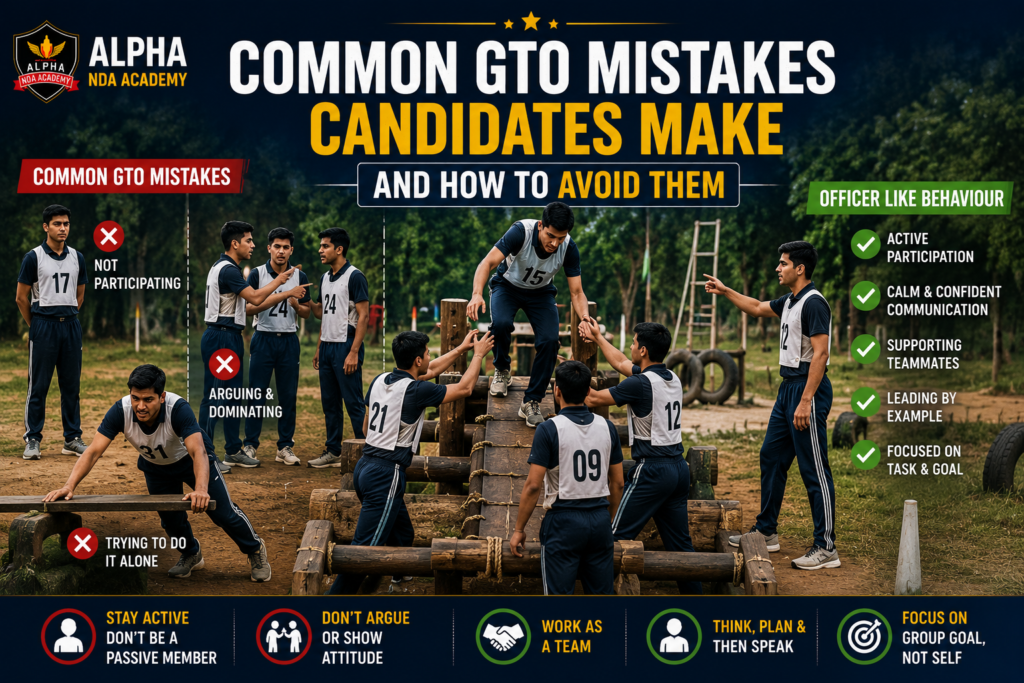
Every SSB batch has that one candidate who walks into the Group Discussion like he has already been told he will be recommended. He speaks from the very first second, interrupts others constantly, brings every point back to his own argument, and by the end of it has dominated maybe 60 to 70 percent of the entire discussion.
Honestly, we understand why this happens. Students think that the person who speaks the most must look like the most confident leader. Especially if they have been told to “show leadership” in GD without being told what that actually means.
Here is what the GTO sees when someone does this: a person who cannot listen. A person who is so focused on being heard that they stop caring about what the group actually needs. That is not a leader. That is a liability.
Real leadership in a Group Discussion means knowing when to speak and when to give others space. It means picking up on what someone said and building on it. It means helping the group reach a conclusion when the discussion is going in circles. If you speak three or four times with solid points and you help the group move forward, that is far more powerful than dominating the entire conversation.
There is a simple thing we tell our students at Alpha NDA Academy: your goal in a GD is not to win the argument. Your goal is to make the group better. Keep that in mind and you will naturally stop making this mistake.
Going Completely Silent and Hoping Nobody Notices
Now the opposite mistake, and honestly this one is just as bad.
Some candidates are naturally shy. Some are afraid of saying something wrong. Some think that staying quiet and observing makes them look mature and composed. None of these reasons change the fact that if the GTO cannot observe your behaviour, he has absolutely nothing to assess.
Think of it this way. The GTO has two days and eight to ten candidates to evaluate simultaneously. He is taking notes, watching interactions, noticing who speaks and who does not, who helps and who stands back. If you do not give him material to work with, you will simply not register as a recommendable candidate.
We have had students come back from SSB and tell us “Sir, I observed everything carefully but I did not want to say something wrong so I stayed quiet.” And the result was not recommended.
You do not need to say perfect things. You need to say things. Participate. Offer your solution even if you are not fully sure it is right. Encourage a quieter teammate to speak. Jump in to help someone across an obstacle before they ask. The GTO is watching for any signs of officer-like behaviour, and silence gives him zero signs.
Force yourself to speak in every single GTO task. That is the only way.
Not Actually Listening to the Rules Before the Task Starts
This one sounds basic. But we see it happen in our own mock sessions all the time.
Before every GTO task, the Group Testing Officer explains the rules. In Progressive Group Task and Half Group Task, he tells you which areas are out of bounds, what materials you can use, and how the materials can be used. In Individual Obstacles, he explains which parts of each structure can and cannot be touched.
What many candidates do during this explanation is listen with half their attention while looking around the ground, sizing up the obstacles, already planning what they are going to do. So by the time the task starts, they are not fully clear on the rules.
And then it happens. Someone steps into an out of bounds zone in the middle of PGT. Or uses a plank in a way that was explicitly prohibited. The GTO notes it. It does not just count as a task error. It counts as a candidate who does not pay attention to instructions, which is a serious concern in an officer.
The fix is simple: give your complete attention when the GTO is explaining the rules. If something is unclear, ask before the task starts. Once the task begins, keep the rules in the back of your mind at all times, especially when things get intense and the group is moving fast. Slowing down by five seconds to check you are following the rules is far better than racing ahead and breaking them.
Treating PGT and HGT as a Personal Performance
Progressive Group Task and Half Group Task are group obstacle challenges. The whole group crosses a series of increasingly difficult obstacles using planks, ropes, and a load. The key word there is group.
What we see sometimes, especially with physically strong or very athletic candidates, is this: the moment the task starts, they basically take over. They lift everything, jump across themselves, set the planks, and complete most of the obstacle while the rest of the group watches or barely contributes. They finish thinking they did great.
They did not.
The GTO is watching whether you can work as part of a team. If you do everything yourself, you have shown that you cannot. And if a quieter or less physically capable teammate is struggling at an obstacle and you walk past them to move ahead, that is something the GTO will notice and it does not reflect well.
Think about who the armed forces actually need. Not someone who is the strongest individual in a room. Someone who can bring a team together, use everyone’s strengths, and get the whole group to the finish line. That is what PGT and HGT are designed to test.
Help your teammates before you cross. Include everyone in the decision of how to approach the next obstacle. If someone has an idea, give them a moment to explain it rather than immediately jumping ahead. Use your physical ability to support the group, not to replace it.
Playing It Safe in the Command Task
Command Task is the one GTO activity that is entirely about you. The rest of the group becomes your subordinates and the GTO gives you an obstacle to compete with your team. This is your individual leadership moment.
And what do most candidates do when they get to choose their obstacle? They pick the easiest one.
This is understandable. Nobody wants to fail in front of the GTO. But picking the easiest obstacle is itself a signal. It tells the GTO that you prefer comfort over challenge. That when you are given responsibility, your instinct is to minimise risk rather than take on something meaningful. These are not qualities the armed forces look for in their officers.
On the other end of the spectrum, some candidates choose a difficult obstacle but then spend the entire task giving instructions from the side while their subordinates do everything. They think leading means directing. It does not.
A good Command Task looks like this: you choose an obstacle that genuinely challenges your team, you explain the plan clearly before starting, you participate actively alongside your subordinates, and when something does not go as expected, you adjust the plan calmly and keep moving. The GTO wants to see how you handle responsibility, not whether you can shout instructions.
Reading From Your Notes in Lecturette
Lecturette is a short individual speaking task. You are shown four topic cards, you choose one, get three minutes to prepare, and then speak for three to four minutes in front of your group.
Two things go wrong here very consistently.
The first is choosing a topic that runs dry after 90 seconds. Some candidates pick a topic because it sounds impressive, not because they actually have things to say about it. So they make two points, slow down, repeat themselves, and then just stop. Three minutes of silence or rambling at the end is painful for everyone.
The second thing is reading directly from the rough notes you wrote during preparation time. Your notes are supposed to be a structure, a few keywords to keep you on track. When a candidate reads from them word by word, it breaks all eye contact, makes the delivery flat and lifeless, and defeats the entire purpose of the task which is to see how you communicate.
When choosing your topic, go with the one where you can naturally think of five or six real points without straining. During your three minute preparation, write only keywords. Not sentences, just words that remind you of each point. When you stand up to speak, look at your group, not your paper. If your mind goes blank on a point, give a brief example about it and move to the next one.
Practice this before your SSB. Lecturette feels very different when you have done it twenty times versus the first time you ever do it standing in front of eight strangers.
Making a Plan in GPE That Cannot Actually Work
Group Planning Exercise is a map based task where the GTO presents your group with a scenario. On the map, there are several problems: maybe a road accident here, a fire there, a missing child somewhere else. Your group has to discuss the problems and come up with one final plan that addresses all of them within the given time using the resources shown on the map.
The most common mistake here is building a plan that sounds logical in the room but is completely impossible in reality.
For example, one person suggests sending a single individual to three different locations that are 8 kilometres apart within 20 minutes. Another proposes using a boat that is shown on the map but is clearly on the opposite bank with no way to reach it in time. Or the plan completely forgets to address one of the problems shown.
Another version of this mistake is when one candidate just tries to push their own plan through without listening to the group. GPE is a group discussion and a group decision. A plan that nobody else understood or agreed on is not a good plan, even if it is technically correct.
Before you start suggesting solutions, read the map carefully. Note the distances between locations. Think about how long realistic travel times would be. Check what resources are actually available and reachable. Then offer your solution and be genuinely open to what others are saying. The final plan should make real world sense.
Checking If the GTO Is Watching You
This one is subtle but very revealing.
During GTO tasks, some candidates keep glancing toward the GTO. After doing something they think was impressive, they look over to see if he noticed. If they are unsure about something, they look at him for a signal. They are essentially performing for him rather than engaging with the actual task.
The GTO always notices this. And it immediately changes how he interprets everything that candidate does. Because if you are performing for the GTO, your actions are not natural. They are calculated. And calculated behaviour is not what the SSB is looking for.
The GTO is not your audience. Your group is your focus. The task is your problem. The moment you start playing to the assessor, you lose the authenticity that gets candidates recommended.
Once a task starts, forget the GTO is there. Focus on your team and on solving the problem in front of you. Everything that naturally comes out of that genuine engagement is exactly what the GTO wants to see.
Letting Your Body Language Tell the Wrong Story
Before you say a single word in any GTO task, your body language has already communicated something.
Hunched shoulders say you are not confident. Sitting at the edge of the group during GD says you do not want to be there. Arms crossed during a task say you are closed off. Constantly looking down at the ground says you are nervous and unsure. These signals are read by the GTO even when no task is formally happening.
And in outdoor tasks, moving with no energy or enthusiasm, dragging your feet between obstacles, standing with your hands in your pockets while your group is working, all of these send the message that you are not really invested.
You do not need to be theatrical about it. Just sit up straight. Keep your shoulders back. Make natural eye contact during discussions. When you are listening to someone in the group, turn your body toward them. During outdoor tasks, move with intention and energy.
This is one of those things that is very hard to change on the day of your SSB if it is not your natural habit. Which is why at Alpha NDA Academy, we work on this from the very beginning of preparation, not just before SSB. The way you sit in class, the way you present yourself during morning PT, the way you carry yourself during group activities, all of it is training for this.
Falling Apart When Something Goes Wrong in a Task
Things go wrong in GTO tasks. Planks fall. The group disagrees. Time runs out before the task is complete. The plan that seemed perfect on paper does not work once the actual obstacle is in front of you.
How a candidate responds to these moments is something the GTO observes very carefully. Because in real military situations, things go wrong. Equipment fails. Plans change. Orders need to be adapted. The question is: does this person stay functional under pressure or do they collapse?
When a candidate panics, starts blaming teammates, goes completely quiet, or visibly gives up when something goes wrong, that is a very clear signal that they are not ready to lead in difficult conditions.
Staying calm when things go sideways is actually one of the strongest things you can show a GTO. It does not mean being emotionless. It means taking a breath, quickly thinking about what can be done now with the time and resources remaining, and keeping the group moving forward. Even if the task does not get completed perfectly, finishing it as a calm and unified group is far better than a chaotic failed attempt.
Not Being Ready Physically for Individual Obstacles
Individual Obstacles is a series of 10 physical structures of increasing difficulty. These include things like Burma Bridge, Tarzan Swing, Commando Walk, Jumping Platforms, and similar obstacles. You attempt them in sequence and your completion is recorded.
We have seen very sharp, well spoken candidates struggle badly here simply because they had never done any physical preparation before coming to SSB. They were good in GD, strong in GPE, active in PGT. But when Individual Obstacles came, they could not get through more than four or five structures because of poor upper body strength or fear of height.
Every incomplete obstacle is a missed opportunity. And a sequence of incomplete obstacles says something about your stamina and confidence that the rest of your performance cannot fully undo.
Before your SSB, work on pull ups, push ups, rope climbing if you can access it, and basic grip strength exercises. Run regularly. Build the kind of general fitness that makes you comfortable moving through physical challenges without fatigue or anxiety.
This is something our students at Alpha NDA Academy work on from Day 1 of joining. The GTO ground on our campus has real obstacle structures and students practice on them as part of their regular weekly training. By the time they reach the actual SSB, they have already crossed these obstacles many times and the physical confidence is already there.
Being Dismissive or Rude Toward Other Candidates
This one we want to say clearly because it matters more than people realise.
During GTO tasks, especially when the group is under time pressure, it is very easy to slip into dismissive behaviour. Someone offers an idea and you say “that won’t work” without explaining why. Someone is moving slowly at an obstacle and you move past them without checking if they need help. Someone in the GD makes a point you disagree with and you roll your eyes or wave it off.
These things happen quickly and feel small in the moment. But the GTO is watching group dynamics constantly, and how you treat other people during stress is one of the most honest reflections of your character.
An officer is respected by their team, not feared. And respect comes from how you treat people. If you are dismissing your peers in GTO tasks, the GTO is making a note about what kind of leader you are.
You can disagree. You can push back on bad ideas. But do it with respect. Say “I see what you mean, but maybe we should also think about this” rather than shutting someone down. Help a struggling teammate rather than leaving them behind. Acknowledge good contributions from others. These small things, done consistently across two days of GTO tasks, build a picture of a genuinely good team player and that is exactly what the armed forces want in their officers.
Why Reading About These Mistakes Is Not Enough
Here is something we want to be very honest about.
You can read this entire article, understand every point, nod at each one, and still walk into SSB and make half of these mistakes. Not because you did not pay attention. But because when you are actually in the middle of a GTO task, with eight other candidates around you, a time limit running, and pressure on, your trained habits take over. Not your knowledge.
If your habits have not been trained, the wrong behaviours will come out naturally. The candidate who has been in thirty mock Group Discussions will not dominate the first real one because silence feels more comfortable than their practiced behaviour. The student who has been climbing real obstacle structures every week will not freeze at the Burma Bridge.
This is why at Alpha NDA Academy we do not keep SSB preparation separate from daily training. We start it from the very first week.
Our campus has a full GTO ground with real obstacle structures. Our students do Group Discussion practice daily, on varied topics, with faculty observing and giving specific feedback. They solve GPE map scenarios weekly. They do Lecturette in front of their peers and get corrected on content, eye contact, and delivery. They do mock Command Tasks. They practice Individual Obstacles physically.
And our SSB guidance panel includes people who have been real members of SSB Selection Boards. They are not teaching from a book. They know exactly what the assessors are looking for because they were the assessors.
The result of all this is that every 1 in 3 students from Alpha NDA Academy gets SSB recommended. That is not luck. That is what consistent, realistic, daily preparation produces.
If you want to see what our SSB Interview Guidance Program looks like in detail, the complete program breakdown is on our website. It is a 25 day intensive program covering everything from GTO tasks to psychology tests to personal interview preparation.
Which Course Helps You Build This From the Ground Up
GTO readiness does not come in 25 days if you have had zero preparation before. It comes from months of regular practice starting early. So depending on where you are right now, here is what makes sense:
If you are currently in Class 10, joining our NDA Foundation After 10th Arjuna Batch gives you two full years to build OLQs, practice GTO tasks, develop communication skills, and prepare your personality alongside your academic preparation. By the time your SSB date arrives, the GTO tasks will feel like home.
In Class 11 or 12 and want to prepare alongside board exams? Our NDA With 12th Bulls Eye Batch balances both. You do not have to choose between board preparation and SSB readiness. We handle both in a structured way.
Finished Class 12 and want to go all in? The NDA After 12th Spartans Batch is a focused one year program where written preparation and complete SSB preparation happen together with no compromise on either.
For girls, our NDA Coaching for Girls program is a dedicated setup with separate hostel facilities, women faculty, and full NDA plus SSB training. GTO tasks matter just as much in women’s SSB and our training covers everything a female aspirant needs.
Already written qualified and just want to focus on SSB? Call us on 7240040400 or message on WhatsApp and we will tell you exactly what to do next.
Frequently Asked Questions About GTO Mistakes in SSB
What is the GTO round in SSB and how many days does it last?
– GTO stands for Group Testing Officer. The GTO round in SSB runs across two days, typically Day 3 and Day 4 of the five day process. It includes Group Discussion (two rounds), Group Planning Exercise, Progressive Group Task, Half Group Task, Individual Obstacles, Command Task, Lecturette, Final Group Task, and sometimes a Snake Race depending on the centre. These tasks collectively evaluate how a candidate behaves, leads, and cooperates in group and individual scenarios.
What is the most damaging GTO mistake a first time candidate makes?
– In our experience, the most damaging mistake is either complete silence or aggressive dominance in group tasks. Both extremes give the GTO a poor picture of the candidate’s ability to function in a team. The ideal behaviour is active, confident, and cooperative participation where the candidate contributes meaningfully, listens genuinely, and helps the group move forward rather than holding it back or taking it over.
Does physical fitness actually matter in GTO tasks?
– Yes, significantly. PGT, HGT, Individual Obstacles, and Final Group Task all require real physical capability. Poor upper body strength, low stamina, or fear of height on obstacle structures can seriously hurt a candidate’s Individual Obstacles performance and also limit how much they can contribute in group tasks. We always tell students: written preparation and physical preparation must go together from Day 1.
Can a weak GTO performance be covered by strong psychology or PI scores?
– Technically yes, in theory. SSB recommendation is a consensus decision by all three assessors during the Conference, and a very strong showing in psychology and PI can sometimes partially offset a below average GTO. But because GTO runs for two full days and covers multiple tasks, a consistently poor performance there is very difficult for other assessors to balance out. It is much better to prepare seriously for all three pillars rather than hoping one offsets another.
How do I prepare for Lecturette before my SSB?
– Practice speaking on a variety of topics for three to four minutes without reading from notes. Start with familiar topics and gradually move to current affairs, national issues, and abstract topics. Record yourself if possible and watch the playback to check eye contact, pace, and content quality. The goal is to be able to pick any topic and speak about it naturally and confidently, not perfectly, just genuinely. Do this at least twice a week for two months before your SSB and the difference will be significant.
What should I do if my group’s GPE plan falls apart mid task?
– Stay calm. Acknowledge what happened quickly, reassess what is still possible with the time remaining, and help the group redirect rather than collapse. The GTO is watching how you handle this moment. A candidate who stays composed, helps the group regroup, and pushes for a revised plan shows far more officer-like qualities than someone who freezes or blames the situation. No plan is perfect. How you adapt is what matters.