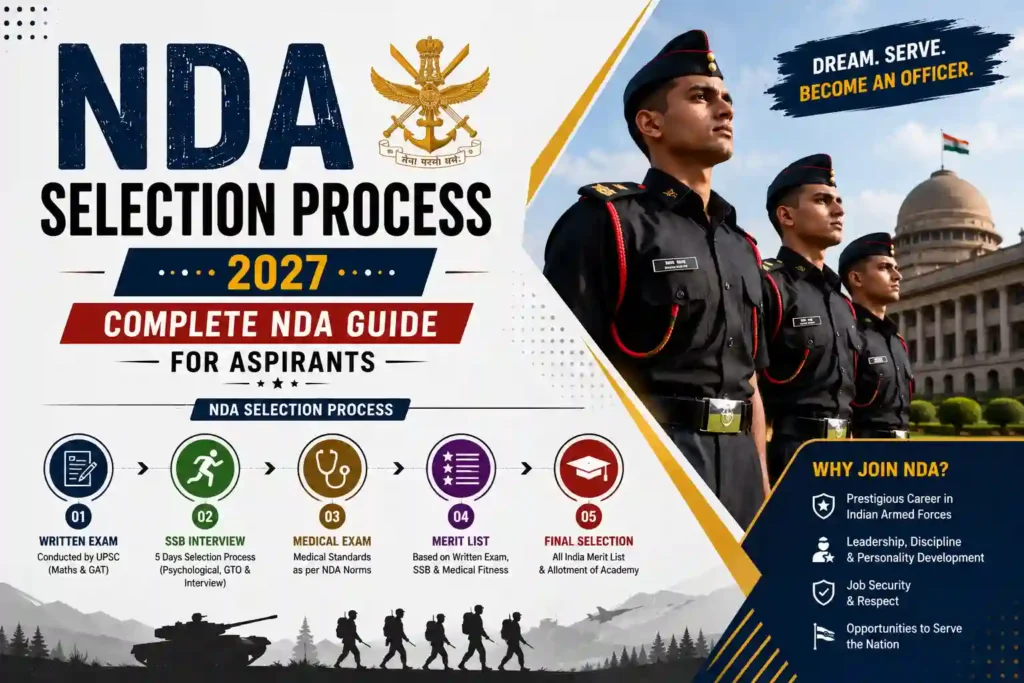
The NDA selection process is a multi-stage procedure for candidates who want to become officers in the Indian Army, Indian Navy or Indian Air Force through the National Defence Academy (NDA). It generally includes the UPSC written examination, the Services Selection Board (SSB) assessment, a medical examination and final merit-based allocation.
Clearing the written exam is only the first major step. Candidates must also demonstrate officer-like qualities, leadership potential, communication skills, psychological suitability and the required medical fitness. Understanding each stage helps aspirants prepare systematically rather than focusing only on Mathematics and the General Ability Test (GAT).
This guide explains the NDA selection process, written exam pattern, SSB interview stages, medical examination, merit list and practical preparation tips for NDA aspirants.

NDA Selection Process 2027: Overview
The selection journey generally follows this sequence:
Stage 1: Apply for the NDA Examination
Complete the UPSC application and meet the prescribed eligibility conditions.
Stage 2: Written Examination
Qualify Mathematics and the General Ability Test (GAT).
Stage 3: SSB Interview
Clear Stage I screening and Stage II psychological, group and interview assessments.
Stage 4: Medical Examination
Undergo the prescribed medical assessment for the service and entry you have applied for.
Stage 5: Final Merit and Allocation
Final selection depends on merit, eligibility, medical fitness, vacancies and service preferences.
The detailed requirements and instructions in the applicable UPSC notification take precedence over any general guide. Refer to the official UPSC NDA examination page for current examination information.
Read Also
Looking for the Best NDA Coaching in India?
Get expert guidance to understand the NDA exam process, eligibility criteria, written exam preparation, and SSB interview.
Start Your NDA Preparation with Alpha NDA Academy!
Call Our NDA Expert Now
1. NDA Eligibility Criteria
Before preparing for the selection stages, candidates should check whether they meet the eligibility requirements for their intended service.
Educational qualification
| Entry or wing | General educational requirement |
|---|---|
| NDA Army Wing | Class 12 pass or equivalent |
| NDA Air Force Wing | Class 12 with Physics, Chemistry and Mathematics, or equivalent |
| NDA Naval Wing | Class 12 with Physics, Chemistry and Mathematics, or equivalent |
| Indian Naval Academy 10+2 Cadet Entry | Class 12 with Physics, Chemistry and Mathematics, or equivalent |
Candidates appearing in Class 12 may also be eligible, subject to the conditions in the relevant notification. Always verify the precise qualification and documentary requirements for your examination cycle.
Age and other eligibility conditions
NDA eligibility also includes conditions relating to age, marital status, nationality and medical fitness. The permitted date-of-birth range can vary between examination cycles, so candidates should use the exact dates specified in the relevant notification rather than relying on a generic age range.
2. NDA Written Examination
The first competitive selection stage is the written examination conducted by the Union Public Service Commission (UPSC). It tests mathematical ability, English proficiency, general knowledge and broader awareness.
NDA exam pattern
| Paper | Maximum marks | Duration |
|---|---|---|
| Mathematics | 300 | 2 hours 30 minutes |
| General Ability Test (GAT) | 600 | 2 hours 30 minutes |
| Total | 900 | 5 hours |
The written exam consists of objective-type questions. Negative marking applies to incorrect answers, so candidates should balance speed with accuracy. The exact marking instructions in the relevant notification should be checked before the examination.
Mathematics paper
The Mathematics paper tests concepts generally taught at the school level, with emphasis on applying formulas and solving problems accurately.
Major topics include:
Candidates should build strong conceptual foundations and practise timed multiple-choice questions regularly.
General Ability Test (GAT)
The GAT carries 600 marks and includes two broad areas:
English: Grammar, vocabulary, comprehension and the ability to use the language correctly.
General Knowledge: Physics, Chemistry, General Science, History, Geography and current affairs, as outlined in the official syllabus.
A balanced preparation plan matters because Mathematics and GAT together account for 900 written-examination marks.
What happens after the written examination?
UPSC announces the written result. Candidates who qualify according to the prescribed requirements are called for the next selection stage. Candidates should follow the official instructions for registering with the relevant recruiting authority and completing the SSB call-up process.
3. NDA SSB Interview Process
The Services Selection Board (SSB) assessment evaluates whether a candidate has the qualities required to become an officer in the Armed Forces. It goes beyond academic knowledge and considers personality, reasoning, teamwork, decision-making, communication and leadership potential.
The SSB process has two main stages. Candidates must clear Stage I to proceed to Stage II.
Stage I: Screening Test
Stage I generally includes the following assessments:
1. Officer Intelligence Rating (OIR) tests
These assess verbal and non-verbal reasoning, logical thinking and problem-solving ability.
2. Picture Perception and Description Test (PPDT)
Candidates observe a picture, form a story based on it and participate in a discussion. The assessment looks at how they interpret situations, communicate ideas and interact with others.
Candidates who do not qualify at the screening stage are sent back according to the applicable SSB procedure. Those who qualify proceed to Stage II.
Stage II: Psychological Tests, GTO Tasks and Interview
Stage II assesses a candidate through multiple techniques. These generally include:
These may include the Thematic Apperception Test (TAT), Word Association Test (WAT), Situation Reaction Test (SRT) and Self Description Test (SDT). They help assess patterns of thinking, responses to situations and personality characteristics.
These include group discussions, planning exercises, group tasks, outdoor obstacles and individual activities. Candidates are assessed on teamwork, initiative, cooperation and practical problem-solving.
The interviewing officer may ask about the candidate’s family, education, interests, daily routine, achievements, decisions and motivation to join the Armed Forces. Honest, clear and consistent answers are important.
Assessors discuss the candidate’s overall performance before the final recommendation decision. Candidates may be asked a few questions during the conference.
The SSB assesses candidates holistically rather than treating one activity as the sole deciding factor. Candidates should focus on developing genuine officer-like qualities instead of memorising supposedly perfect answers.
4. NDA Medical Examination
Candidates recommended by the SSB must undergo the prescribed medical examination. The medical assessment checks whether they meet the applicable physical and medical standards for the service and entry.
Medical requirements may cover:
Standards can differ according to service, branch and applicable rules. Air Force flying-related roles may have additional requirements. Candidates should read the official medical standards rather than relying on social media claims or general fitness charts.
Important: SSB recommendation does not automatically mean final selection. Medical fitness and the other prescribed selection conditions must also be satisfied.
5. NDA Final Merit List and Selection
After the written examination and SSB assessment, the final selection process considers the candidate’s combined performance and eligibility.
The written examination carries 900 marks, and the SSB assessment carries 900 marks, making the combined assessment total 1,800 marks under the standard scheme. Separate minimum qualifying requirements may apply to the written exam and SSB assessment.
Final allocation depends on factors such as:
Candidates should understand that being recommended by the SSB and being included in the final selection list are different outcomes. Final admission depends on the applicable rules and the availability of vacancies.
6. What Happens After Final Selection?
Candidates who are finally selected receive joining instructions according to the service and course allocated to them.
The broad journey is:
- Complete the prescribed selection stages.
- Meet the medical and eligibility requirements.
- Be considered for final merit and allocation.
- Receive joining instructions if selected.
- Report to the allotted training institution as directed.
Training, commissioning pathways and subsequent career progression depend on the service and entry. Candidates should follow the official joining instructions carefully and submit all required documents within the stated timelines.
7. How to Prepare for the NDA Selection Process
A successful NDA preparation plan should cover the written examination, SSB assessment and physical fitness. Focusing only on academic subjects can leave candidates underprepared for the later stages.
Build a strong written-exam foundation
Start SSB preparation early
SSB preparation should focus on self-awareness and the ability to express your thoughts clearly.
There is no need to pretend to have a perfect personality. Consistency, self-awareness and genuine improvement are more useful than memorised responses.
Maintain physical fitness
Develop a regular routine that includes running, mobility work, strength exercises and adequate recovery. Maintain healthy sleep and nutrition habits. Physical preparation should be progressive and appropriate to your current fitness level.
Physical fitness training supports overall readiness, but it does not replace the official medical examination or guarantee medical qualification.
8. Common Mistakes NDA Aspirants Should Avoid
| Common mistake | Better approach |
|---|---|
| Preparing only for Mathematics | Give sufficient time to GAT and English |
| Ignoring negative marking | Practise accuracy and sensible question selection |
| Starting SSB preparation after the written result | Build communication, awareness and teamwork throughout preparation |
| Memorising answers for the interview | Use truthful examples and explain your reasoning clearly |
| Neglecting physical fitness | Maintain a consistent, safe exercise routine |
| Relying on unofficial eligibility information | Verify age, qualification and medical rules in the official notification |
| Assuming SSB recommendation guarantees admission | Understand medical, merit, vacancy and allocation requirements |
9. NDA Selection Process: Practical Preparation Timeline
Use this sample plan as a starting point and adjust it to your current academic level and examination date.
Phase 1
Foundation
Build the basics
Complete core Mathematics concepts, English fundamentals, science topics and general knowledge. Begin regular exercise and reading.
Phase 2
Practice
Improve speed and accuracy
Solve previous papers, practise timed questions, take mock tests and review your errors. Continue building communication and reasoning skills.
Phase 3
Revision
Prepare for the full selection journey
Revise weak areas, practise full-length papers, maintain fitness and learn about the SSB stages. If shortlisted, follow the official reporting instructions.
10. How Alpha NDA Academy Can Support Your Preparation
Preparing for NDA requires a structured approach to academics, regular practice, discipline and awareness of the complete selection process. Students may benefit from guided classes, mock examinations, performance feedback and opportunities to develop communication and personality skills.
Alpha NDA Academy in Sikar, Rajasthan, offers NDA preparation programmes for students at different academic stages. Aspirants can explore the available programmes to identify an option that fits their schooling stage and preparation needs.
Relevant course pages:
Frequently Asked Questions (FAQs)
1. What are the stages of the NDA selection process?
The process generally includes the UPSC written examination, SSB assessment, medical examination and final merit-based allocation. Candidates must satisfy the applicable eligibility conditions at each stage.
2. How many marks are required to clear the NDA written exam?
There is no single fixed score that guarantees qualification in every examination cycle. UPSC determines the applicable minimum qualifying requirements, and the cutoff may vary. Candidates should check official results and cutoff information for the relevant examination.
3. Is the NDA SSB interview compulsory?
Yes. Candidates who qualify in the written examination must undergo the prescribed SSB assessment to continue in the selection process.
4. How many days does the NDA SSB process take?
The SSB process commonly spans several days. Stage I screening takes place on the first day, and candidates who qualify proceed to the subsequent assessments. Follow the reporting and scheduling details in your call-up instructions.
5. What happens if a candidate fails Stage I of the SSB?
Candidates who do not qualify the initial screening are not allowed to continue to Stage II in that SSB attempt and are sent back according to the prescribed procedure.
6. Is the NDA medical examination compulsory after SSB?
Yes. Candidates recommended by the SSB must undergo the prescribed medical assessment and meet the applicable standards to remain eligible for final selection.
7. Are written-exam marks counted in the final NDA merit list?
Yes. Under the standard NDA selection scheme, the written examination carries 900 marks and the SSB assessment carries 900 marks. Final selection also depends on eligibility, medical fitness, vacancies and the applicable allocation rules.
8. Can a Class 12 student apply for NDA?
Eligible Class 12 students may apply subject to the conditions in the relevant notification. Educational requirements differ by wing, so applicants should verify the precise criteria before submitting their application.
9. Can girls apply for the NDA examination?
Yes. Eligible female candidates can apply under the applicable NDA admission rules. They must satisfy the prescribed eligibility, selection and medical requirements.
10. Where can I find official information about NDA selection?
Use the UPSC official website and the relevant NDA examination notification for eligibility, examination rules, results and official instructions.
Start Your NDA Preparation with Alpha NDA Academy
If you are preparing for the NDA examination and need structured guidance, classroom-based preparation, regular tests, mentorship and SSB-focused training, Alpha NDA Academy in Sikar provides NDA preparation programmes for students at different academic stages.
Call Alpha NDA Academy: 72400 40400
Explore NDA Courses: https://alphandaacademy.in/