WAT (Word Association Test) How to Prepare
WAT (Word Association Test) How to Prepare
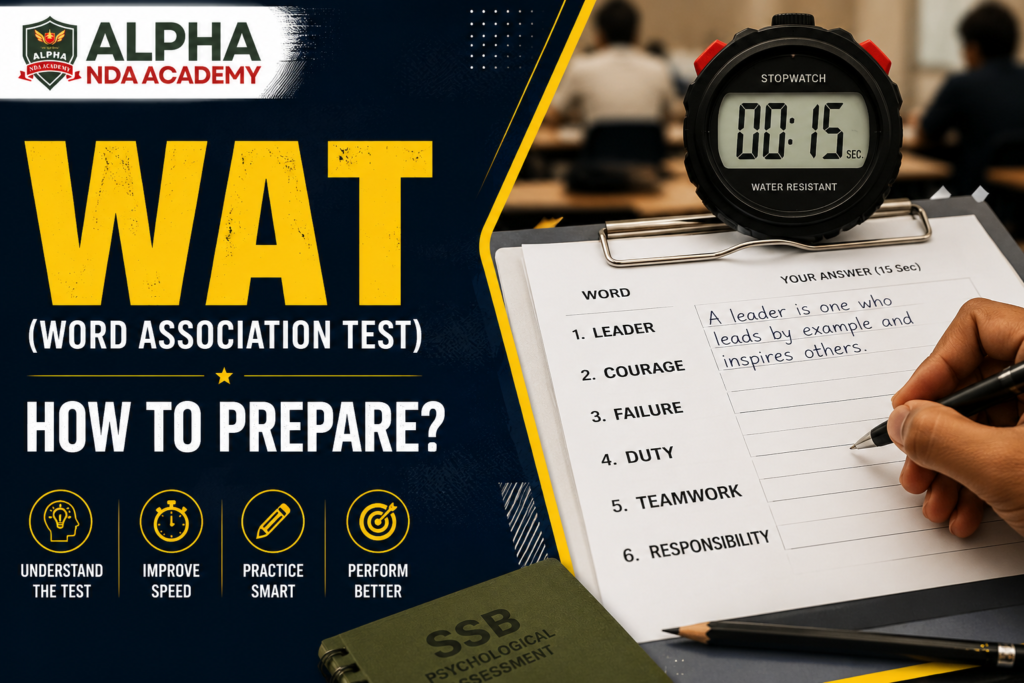
Sixty words. Fifteen seconds each. One complete sentence per word. No pausing. No going back. No second chances.
That is the WAT the Word Association Test and it is the second psychological test you face on Day 2 of your SSB interview. Right after the TAT wraps up, the psychologist moves directly to this test. The screen lights up. The first word appears. The clock starts.
For the next fifteen minutes, your job is simple on paper but deeply revealing in practice: you write what your mind says first. That is exactly why this test is designed the way it is because your first instinct, repeated sixty times under pressure, tells the psychologist far more about who you are than any interview question ever could.
We have trained hundreds of students for SSB at Alpha NDA Academy, and when it comes to WAT, we have seen two types of candidates. The first type walks in thinking this is just a sentence–making exercise they try to sound smart, use big words, or force the word into something dramatic. The second type understands that WAT is a personality mirror and they practise building the kind of personality that produces naturally strong responses. The second type gets recommended. The first type usually does not.
This guide is everything we know about WAT condensed into one complete, practical resource. Read it from start to finish. Then practise. Then read it again before your SSB.
What Is WAT And Why Is It Used in SSB?
WAT stands for Word Association Test. It is a projective psychological tool used to understand a person’s subconscious thought patterns, personality traits, and emotional responses by seeing how they react to single words under time pressure.
The concept of word association testing was first introduced by British scientist Francis Galton in 1879. It was later developed further by Carl Jung and Sigmund Freud as a tool to explore the unconscious mind. The reason it worked so well as a psychological instrument is that when a person sees a word and has only a few seconds to respond, they bypass their conscious, controlled thinking and reveal their natural personality.
In India’s SSB interview system, the WAT has been adapted by the Defence Institute of Psychological Research (DIPR) specifically to assess the 15 Officer–Like Qualities (OLQs) required of a future defence officer. The 60 words shown to candidates are not random; they are carefully chosen to provoke different kinds of responses across multiple personality dimensions.
The psychologist is not reading one sentence at a time. They are reading all 60 responses together, looking for patterns. Your responses become a personality sketch and that sketch either looks like a future officer or it does not.
Where WAT Fits in the 5-Day SSB Process
Before going into how to prepare, let us place WAT clearly inside the SSB structure because understanding the sequence matters.
We have a detailed breakdown of the full SSB experience in our SSB Interview 5-Day Process guide but here is where WAT specifically sits:
Day 1 Screening Stage: OIR Test + PPDT. Only candidates who clear this proceed to Day 2.
Day 2 Psychology Tests (four tests in sequence):
- Test 1: TAT (Thematic Apperception Test) 12 pictures, write a story for each
- Test 2: WAT (Word Association Test) 60 words, 15 seconds each
- Test 3: SRT (Situation Reaction Test) 60 situations in 30 minutes
- Test 4: SD (Self Description Test) write how others see you
Day 3 and 4 GTO Tasks
Day 5 Conference
WAT is the second of four psychology tests, conducted immediately after TAT. If you have already read our TAT complete guide, you know how the psychologist builds a personality picture from TAT stories. WAT adds another layer to that picture: a faster, more instinctive layer.
The psychologist compares your WAT responses with your TAT stories, SRT reactions, and SD descriptions. All four must show the same consistent personality. If your TAT hero is brave and initiative–driven but your WAT responses are passive and gloomy, the inconsistency raises red flags.
The Exact WAT Format What Happens in the Room
Here is the precise, verified breakdown of the WAT session:
Total words: 60 All 60 words are shown one at a time on a projection screen. There are no multiple–choice options, no blanks to fill just a word and a blank space in your booklet to write your response.
Time per word: 15 seconds As soon as the word appears, the 15-second countdown starts. The moment the 15 seconds end, the word disappears and the next one immediately appears. There are no breaks between words. The speed is deliberate. 15 seconds is just enough to write a short sentence if you do not overthink.
Total duration: Approximately 15 minutes 60 words × 15 seconds = 900 seconds = 15 minutes.
Your response format: One complete sentence (or phrase or group of words) written in the booklet against the corresponding serial number. You write before the word disappears so start writing while the word is still visible.
Nature of words: The words can be positive (Leader, Courage, Discipline), neutral (Journey, Rain, House, Family), or negative (Failure, Fear, Danger, Corrupt). The mix tests different aspects of your personality depending on how you respond to each type.
No right or wrong answers: The WAT does not have a correct answer. There is no fixed marking scheme in SSB psychology tests. The psychologist evaluates your responses holistically based on personality patterns and OLQ consistency not individual sentences on a point scale.
What the Psychologist Is Actually Evaluating in WAT
This is the section most candidates miss when preparing. They focus on making their sentences sound good but the psychologist is not looking for nice sentences.
Here is what they are actually reading for:
Your natural thought patterns: The 15-second limit makes it extremely hard to construct a fake response. What you write first is what your mind reaches for naturally. If you have spent months building a positive, responsible, leadership–oriented mindset, your responses will reflect that without effort. If you have not, no amount of practice with a “list of good sentences” will save you because forced sentences look forced.
Emotional stability: Do your responses stay consistently stable across the 60 words? Or do they swing between confident and anxious, positive and negative? Emotional stability is one of the key OLQs, and WAT is one of the best tests for it.
Attitude toward challenges: Negative words are where your attitude is most clearly revealed. How do you respond to “Failure”? To “Fear”? To “Danger”? A candidate who writes negative responses to these words is signalling low mental resilience not the quality the Indian Armed Forces want in an officer.
Social awareness: Do your responses ever show awareness of others, of society, of national issues? Or are they always narrowly focused on the individual? An officer is a socially aware, responsible leader and your sentences should reflect that occasionally.
Consistency with the rest of your psychology picture: The psychologist will compare your WAT with your TAT stories, your SRT reactions, and your self–description. Consistent personality patterns across all four tests build a strong case for recommendation.
The 3 Types of Words in WAT And How to Approach Each
Every WAT session contains three broad types of words. Knowing how to approach each type removes the panic of encountering an unexpected word.
Type 1 Positive Words
These are words that already have a positive meaning. Examples: Leader, Courage, Discipline, Integrity, Success, Dedication, Teamwork, Bravery, Nation, Responsibility.
How to approach them: These are the easiest. Write a sentence that expands on the positive quality naturally. Keep it grounded, do not go overboard with drama.
Good response for “Courage”: Courage drives soldiers to protect the nation even in the most difficult conditions.
Good response for “Teamwork”: Teamwork brings out the best in every individual by combining different strengths.
One mistake to avoid: Do not simply define the word. “Courage is being brave” is a dictionary entry, not a personality response.
Type 2 Neutral Words
These are everyday words with no strong positive or negative charge. Examples: Journey, Rain, House, Family, Road, Train, Work, Book, Time, River, Village.
How to approach them: Neutral words give you the most creative space. You can connect them to social themes, national development, personal values, or leadership whatever flows naturally. The best responses to neutral words are ones that show social awareness or constructive thinking.
Good response for “Village”: Developing rural infrastructure brings equal opportunities to every citizen of the nation.
Good response for “Rain”: Proper water management during monsoon prevents both drought and flooding in agricultural regions.
One mistake to avoid: Do not write a generic or meaningless sentence. “Rain falls from the sky” is a factual description not a personality response.
Type 3 Negative Words
These are the words that make most candidates freeze. Examples: Failure, Fear, Danger, Anger, Corruption, Poverty, War, Accident, Cheat, Problem, Death.
How to approach them: This is where the test gets real. The psychologist is watching closely here. A negative word is not a trap it is an opportunity to show resilience, problem–solving thinking, and emotional maturity.
There are two proven approaches:
Approach A: Turn it constructive: Write a sentence that converts the negative word into a positive direction. “Failure” ? Failure is the most honest teacher of growth and strategy. “Fear” ? Fear disappears for those who prepare thoroughly and believe in themselves. “Anger” ? Channelling anger into focused effort produces the best results.
Approach B Show the solution: Frame the negative word as a problem that has a solution, especially involving collective or social action. “Corruption” ? Strong accountability systems and transparency help reduce corruption effectively. “Poverty” ? Education and vocational training are the most effective tools against poverty. “Accident” ? Road discipline and awareness prevent a majority of accidents across India.
What to avoid with negative words: Never write a genuinely negative sentence. “Failure destroys all hope” or “Fear is always present in danger” signals a pessimistic, emotionally unstable personality. Even if the sentence feels technically honest, it is the wrong message in this context.
The Golden Rules for WAT Sentence Writing
After years of evaluating WAT practice responses from our students at Alpha NDA Academy, here are the rules that consistently separate strong responses from weak ones:
Rule 1 Write a complete sentence, not just a word or phrase. “Courage yes!” is not a sentence. Write a full subject–verb–object structure. “Courage helps leaders make tough decisions quickly” is a proper WAT response.
Rule 2 Keep it short and clear. Aim for 8 to 12 words. You have 15 seconds and you need to write while the word is still displayed. If your sentences consistently run to 20+ words, you will start leaving words blank which the psychologist notices. Practice writing concise, meaningful sentences.
Rule 3 Prefer active voice over passive voice. “The team was led by him” is passive. “He led the team forward with confidence” is active. Active voice signals initiative and confidence both OLQs.
Rule 4 Avoid using “I” or “Me” wherever possible. Use third person “A leader,” “Officers,” “He/She,” “Students,” “Soldiers.” This creates a less personal and more mature tone that fits the officer personality profile better. Most experienced SSB mentors recommend third person for WAT.
Rule 5 Do not write the word itself as the subject of the sentence. “Courage is brave” just defines the word. “Soldiers with courage face every challenge head–on” shows the quality in action.
Rule 6 Never leave a word blank. Even if you are stuck, write something simple and positive. “Hardship builds a stronger and more determined character” works for almost any difficult word. A blank space signals mental avoidance and avoidance is the opposite of an officer–like quality.
Rule 7 Do not force OLQs into every single sentence. If every sentence of your WAT reads like a military slogan, the psychologist sees through it immediately. Be natural. Approximately half your sentences can be social or everyday themes. The OLQs will emerge naturally through your overall pattern.
Rule 8 Avoid religious, political, or controversial content. WAT is not the place for religious beliefs, political opinions, or socially sensitive statements. Stick to social awareness, individual values, national development, and human qualities.
Rule 9 Practice under strict 15-second timing. This cannot be skipped. Writing a good sentence in 30 seconds is a different skill from writing one in 15 seconds. Your speed and quality must match what the actual test demands. Set a timer and practise daily.
How to Handle Negative Words The Most Challenging Part
Negative words are the part of WAT that most students worry about the most and where the most damage is done by unprepared candidates. Let us break this down simply.
When you see a negative word, your brain does one of three things:
- Freezes (leaves the word blank)
- Writes a negative response
- Flips it into something constructive
The psychologist wants to see option 3 every single time.
The Flip Technique: For most negative words, you can flip the meaning by showing what overcomes or prevents the negative thing. The structure is: [solution or quality] + [removes or prevents] + [negative thing].
“War” ? A powerful and prepared defence force is the most effective deterrent against war. “Cheat” ? Honest character and integrity leave no room for dishonesty in any form. “Death” ? Officers who sacrifice their lives are the true guardians of national honour.
The Reframe Technique: For some words, you can reframe the negative word as a pathway to growth.
“Failure” ? Failure is the first chapter of every success story written with persistence. “Pain” ? Pain builds the mental toughness that separates average people from leaders. “Problem” ? Every problem is an opportunity to demonstrate effective decision–making ability.
What to do when you genuinely cannot flip it: For some extremely dark or sensitive words, a simple factual positive sentence works well.
“Suicide” ? Emotional support and community care are vital in preventing mental health crises. “Crime” ? Strong institutions and justice systems protect citizens from criminal activity.
The key principle: even with the darkest words, the direction of your sentence must always be constructive, solution–oriented, and socially aware.
50 Sample WAT Words With Strong Responses
These are drawn from commonly practised WAT word banks used by SSB aspirants across India. Use these to understand the pattern do not memorise them. The goal is to understand the approach, not to rehearse specific sentences.
Positive Words Sample Responses
| Word | Strong Response |
| Leader | A leader builds others by example, not by instruction alone. |
| Courage | Courage allows soldiers to act decisively even under fire. |
| Discipline | Discipline practiced daily becomes the foundation of a successful career. |
| Teamwork | Teamwork multiplies the output of every individual on a team. |
| Confidence | Confidence built through preparation never collapses under pressure. |
| Dedication | Dedicated officers inspire the best performance from their entire unit. |
| Integrity | Integrity in action earns lasting respect from peers and leaders. |
| Success | Success follows those who prepare with focus and never stop learning. |
| Bravery | Bravery is not the absence of fear but the choice to act despite it. |
| Responsibility | Responsible individuals are trusted to lead even in the most difficult situations. |
Neutral Words Sample Responses
| Word | Strong Response |
| Journey | Every challenging journey builds the character needed for greater responsibilities. |
| Rain | Effective rainwater harvesting prevents drought in many water–scarce Indian regions. |
| Village | Rural development brings equal opportunity to the foundation of Indian society. |
| Book | Reading broadens the mind and sharpens decision–making ability in leaders. |
| Time | Time managed with discipline defines the effectiveness of every individual. |
| Family | A supportive family gives every young aspirant the strength to pursue difficult goals. |
| Road | Good infrastructure connects communities and drives national development forward. |
| Training | Rigorous training separates capable leaders from those who merely try. |
| Work | Consistent and focused work brings results that inspiration alone never can. |
| Nation | A strong and united nation is built through the collective efforts of its citizens. |
Difficult or Negative Words Sample Responses
| Word | Strong Response |
| Failure | Failure is the clearest signal of what needs to be improved next. |
| Fear | Preparation and discipline are the most reliable cures for any form of fear. |
| Anger | A leader who channels anger into focus always finds a better solution. |
| Poverty | Skill development and quality education are the most effective tools against poverty. |
| Corruption | Accountability and transparency are the strongest weapons against corruption in any institution. |
| War | A fully prepared armed force is the most powerful deterrent against war. |
| Accident | Safety awareness and traffic discipline prevent the majority of accidents on Indian roads. |
| Problem | Every problem has a solution waiting for someone with the initiative to find it. |
| Danger | Danger is handled best by those who have trained for it consistently. |
| Death | Officers who sacrifice their lives in service of the nation deserve the highest national honour. |
| Defeat | Defeat reveals the gaps that preparation must fill before the next attempt. |
| Cheat | Honesty and character are the strongest protection against dishonesty in any field. |
| Struggle | Struggle shapes the kind of strength that easy paths can never build. |
| Lazy | A disciplined routine removes laziness and builds the habits of a productive life. |
| Enemy | Preparedness and unity are the most effective ways to neutralize any adversarial threat. |
| Alone | Working alone builds self–reliance, while working together builds unbeatable teams. |
| Weak | Identifying weaknesses is the first step toward building genuine strength. |
| Crime | Strong institutions and a just legal system protect communities from criminal activity. |
| Pain | Pain experienced in training prevents far greater pain when facing real challenges. |
| Mistake | Every mistake, acknowledged honestly, becomes a lesson that prevents future errors. |
The Most Common WAT Mistakes We See Every Year
These patterns come up in almost every batch we train at Alpha NDA Academy. Know them. Avoid them.
Mistake 1 Defining the word instead of responding to it. “Courage is when a person is brave.” This is a definition, not a personality response. Write what courage does, not what it means.
Mistake 2 Leaving words blank. A blank response to any word is noticed. Even a simple, moderate sentence is better than nothing. Practise enough that you always have something to write.
Mistake 3 Writing negative responses to negative words. This is the most damaging mistake. If your response to “Failure” is “Failure destroys ambition,” the psychologist reads pessimism and low resilience qualities that disqualify an officer.
Mistake 4 Memorising a list of prepared sentences and using them. Experienced psychologists have seen thousands of WAT booklets. Memorised responses stand out immediately; they feel disconnected from the rest of your personality picture. Practice thinking, not memorising.
Mistake 5 Writing about joining the army for every other word. “Discipline. I want to join the army to be disciplined.” “Courage Soldiers in the army are courageous.” Repeating the army theme constantly looks manufactured and narrow–minded.
Mistake 6 Using passive voice throughout. A passive voice signals a passive personality. “The problem was solved by the team” vs “The team solved the problem decisively.” The second version is stronger in every way.
Mistake 7 Inconsistency within the WAT itself. If most of your sentences are positive and socially aware but three or four are inexplicably gloomy or negative, the psychologist notices the inconsistency and investigates what it signals.
Mistake 8 Spending time rewriting or editing. There is no time to edit in WAT. If you make a mistake, move on. Crossing out words wastes precious seconds and leaves a visually cluttered booklet. Write once, move forward.
Mistake 9 Not practising under actual 15-second conditions. Writing good WAT sentences in 60 seconds is easy. Writing them in 15 seconds, for 60 consecutive words, without a single blank that requires serious daily practice. Most students skip timed practice and it shows.
Mistake 10 Treating WAT as separate from the rest of SSB psychology. Your WAT responses must be consistent with your TAT stories, SRT reactions, and self–description. If your TAT hero is courageous and your WAT response to “Fear” is that fear is overwhelming, the inconsistency weakens your overall assessment.
WAT vs TAT The Key Differences Every Student Must Know
Students often confuse WAT and TAT preparation strategies because both are psychology tests on Day 2. Here is a clean comparison:
| Factor | TAT | WAT |
| Format | 12 pictures, write a story per picture | 60 words, write one sentence per word |
| Time per stimulus | 30 sec view + 4 min writing | 15 seconds total per word |
| Length of response | 100 to 150 words per story | 8 to 12 words per sentence |
| Focus | Narrative, personality through storytelling | Instinctive reaction, raw thought patterns |
| Recovery if weak | No | No each word stands alone |
| What it reveals | Values, problem–solving through story | Subconscious attitudes, emotional stability |
The key takeaway: both tests demand consistency. The same personality proactive, positive, socially aware, responsible, confident must emerge from both your TAT stories and your WAT sentences. A psychologist who reads both will see either a consistent officer profile or a contradictory one.
If you want a complete understanding of TAT, read our full TAT Complete Guide.
A 21-Day WAT Practice Plan
Three weeks is a realistic and effective preparation period for WAT if you are consistent. Here is exactly how to structure it:
Days 1 to 5 Learning and Pattern Recognition Do not start writing yet. In these five days, focus on understanding. Read about the 15 OLQs clearly. Understand what each quality means in real–life behaviour. Read ten to fifteen sample WAT words with strong responses and analyse why each response is strong which quality does it show? Why does it avoid the mistake of defining the word?
By the end of Day 5, you should know exactly what the psychologist is looking for.
Days 6 to 10 Slow Deliberate Practice Start writing 20 WAT words per day but without a strict timer yet. Focus purely on quality. For each word, write a sentence that is concise, active voice, positive, and shows at least one quality naturally. Include a mix of positive, neutral, and negative words.
After writing, read your responses and ask: Does this sentence sound natural? Does it show a real quality through action? Would I be comfortable if a retired army officer read this?
Days 11 to 16 Timed Practice Now add the timer. Set a 15-second countdown for each word. Write 30 words per day under strict timing. Focus on leaving no blanks. It is okay if some sentences are simpler during this phase speed and completeness matter more right now.
Track which word types slow you down the most. Students who are slow on negative words need extra practice converting them. Students who are slow on neutral words need to practise connecting them to social themes.
Days 17 to 21 Full Sets Under Test Conditions Write complete 60-word sets daily under exactly 15 seconds per word as close to real test conditions as possible. After each full set, read all 60 responses together. Ask yourself: Does this look like one consistent personality? Are there any obviously negative responses? Are any responses blank?
By Day 21, your brain should be conditioned to respond quickly and naturally with the kind of thinking the psychologist expects to see.
How Alpha NDA Academy Trains Students for WAT
At Alpha NDA Academy, Sikar ranked the number 1 NDA coaching institute in Rajasthan WAT preparation is not something we do as a last–minute add–on before SSB. It is built into the daily preparation of every student from Day 1.
Here is how we approach it:
Daily Psychology Sessions: Every student practises TAT, WAT, SRT, and SD under timed conditions regularly throughout the batch not just in the weeks before SSB. The reason is simple: the personality reflected in WAT takes months to develop, not weeks to memorise.
Individual Response Review: After every WAT practice session, our SSB faculty reviews individual responses. We look at each student’s pattern which words trigger weak or negative responses, where the thinking becomes inconsistent, and where memorised sentences are creeping in. Feedback is specific to the student.
Real SSB Simulation: We run complete mock SSB sessions psychology tests on Day 1 of mock SSB, GTO tasks on Day 2, personal interview on Day 3. Students who go through this process once before their actual SSB experience a significant reduction in day–anxiety is the biggest enemy of WAT performance.
SSB Experts with Selection Board Experience: Our SSB faculty includes professionals with actual Services Selection Board experience. They know how psychologists read WAT booklets because they have been part of the process. This is not coaching from a textbook, it is coaching from people who have sat on the other side of the table.
Free 25-Day SSB Coaching for Written Qualifiers: Every NDA or CDS aspirant who clears the written exam and joins Alpha NDA Academy receives 25 days of dedicated SSB preparation including full WAT, TAT, SRT, and SD practice sessions with individual feedback at no additional charge.
What Genuinely Improves Your WAT Performance
This is the section most guides skip. Beyond practice sets and sample words, here is what actually changes how a person performs in WAT:
Reading a newspaper every morning: Current affairs awareness shows up in WAT responses to neutral and national–theme words. A student who reads the newspaper regularly writes naturally about rural development, national security, economic progress, and environmental issues because these topics are part of their everyday thinking. This makes their WAT responses feel informed and genuine.
Building vocabulary of ideas, not words: WAT does not require sophisticated vocabulary. It requires a rich vocabulary of ideas meaning you should know multiple positive, constructive angles from which to approach any situation. Reading biographies of leaders, stories of social change, and accounts of military operations gives your mind more angles.
Practising daily habits that reflect OLQs: The fastest way to improve WAT is to actually live the qualities you want your sentences to reflect. Take initiative in your hostel group. Take responsibility for small tasks. Speak up in discussions. Make decisions quickly in everyday situations. When these become natural behaviours, your WAT sentences naturally reflect them without effort.
We have shared 15 specific habits that every NDA aspirant should be building, and most of these directly feed into better WAT responses: 15 Good Habits Every NDA Aspirant Must Have.
Staying physically active: This sounds unrelated but it is not. Physical fitness builds mental stamina, discipline, and confidence all of which show up in WAT responses. Students who follow a rigorous daily fitness routine tend to have more naturally assertive, action–oriented WAT sentences than those who do not.
For more on how to keep your overall NDA and SSB preparation on track, the NDA Preparation Tips 2026 guide gives you a complete framework.
Frequently Asked Questions About WAT in SSB
Q. How many words are in WAT?
A. There are 60 words in total, shown one at a time on a screen.
Q. How much time is given per word?
A. 15 seconds per word. The entire WAT session lasts approximately 15 minutes.
Q. Should I write in first person or third person?
A. Prefer third person “A leader,” “Soldiers,” “He,” “She,” “The team.” First person (I, me) occasionally is acceptable, but overdoing it makes responses feel self–centred. Most SSB mentors recommend a predominantly third–person approach.
Q. Is grammar checked in WAT?
A. No. The psychologist is not evaluating your English grammar. They are evaluating your thought patterns and personality. Simple, clear, and correctly directed sentences matter far more than grammatically perfect ones. That said, write legibly illegible responses cannot be assessed.
Q. What if I cannot think of a sentence within 15 seconds?
A. Write anything simple and positive. A basic but constructive sentence is infinitely better than a blank. Practice daily timed sessions so this situation becomes rare.
Q. Can I write the same theme for every word?
A. No. Repeating the same theme like the army or patriotism for most words looks rehearsed and narrow. Show variety: social themes, personal values, national issues, leadership, cooperation, family values. Variety shows a well–rounded personality.
Q. What happens if I get a very dark negative word?
A. Approach it with the flip or reframe technique explained earlier in this guide. Convert the dark word into a constructive direction. Even “Death” has a strong response in a defence context: “Officers who sacrifice their lives in service remain the greatest inspiration for every generation.”
Q. Is WAT more important than TAT?
A. Neither is more important in isolation. The psychologist evaluates all four psychology tests TAT, WAT, SRT, and SD together. A strong performance in one test does not cancel out a weak performance in another. All four must reflect the same consistent personality.
Q. How many weeks should I practise WAT before SSB?
A. At a minimum, three weeks of consistent daily practice. Ideally, start WAT practice two to three months before your expected SSB date so the thinking becomes truly natural rather than forced.
Q. Will I see the same words in my actual WAT as in practice sets?
A. Some words overlap with commonly practised ones, but the specific 60 words vary between different SSBs and different cycles. This is why practising the approach matters far more than memorising specific responses.
Building the Daily Mindset That WAT Rewards
The best piece of advice we give every student at Alpha NDA Academy about WAT is this: your sentences on the day of the test will reflect the kind of person you have been for the past few months, not the kind of person you tried to sound like last night.
If you have been reading the news, taking initiative in your daily life, working hard, keeping your fitness up, helping others around you, and building genuine self–confidence through discipline your WAT responses will naturally sound like an officer’s.
If you spend the past few months sitting and memorising lists of “good WAT sentences” the psychologist will see through it, because your TAT stories, SRT reactions, and self–description will not match.
WAT is not a test you crack on Day 2. It is a test you prepare for over months of becoming the right person.
To understand the complete picture of where WAT fits in your journey from the written exam to SSB from application to recommendation read our guide: What Happens After NDA Written Exam and the full NDA Selection Process guide.
And if you are wondering where this entire journey leads to the career, the growth, the salary structure of a commissioned officer, take a look at NDA Officer Salary and Career Growth.
Final Words What WAT Is Really Testing
We want to leave you with one thought that changes how most students approach this test.
WAT is not testing your sentences. WAT is testing your mind.
The psychologist does not care whether you wrote “Courage drives soldiers to protect the nation” or “Courage helps teams achieve difficult goals under pressure.” Both are strong. What the psychologist cares about is whether across 60 words your mind keeps returning to the same positive, proactive, responsible, and action–oriented outlook.
That outlook is not built in a day of practice. It is built over months of living like a future officer waking up early, reading the news, maintaining fitness, helping others, and taking responsibility for things even when no one is watching.