SSB Psychological Tests Explained — TAT WAT SRT SDT Guide For Serious Defence Aspirants
SSB Psychological Tests Explained — TAT WAT SRT SDT Guide For Serious Defence Aspirants
SSB Psychological Tests Explained — TAT WAT SRT SDT Guide is important for every defence aspirant who wants to understand how psychology is assessed during the SSB interview.
These tests are not about memorising perfect answers, but about showing your real thinking, decision-making, emotional balance, and officer-like qualities in a natural way.
Many students feel nervous when they hear names like TAT, WAT, SRT, and SDT because these tests happen quickly and leave very little time to think.
But once you understand their purpose and practice in the right way, they become a strong opportunity to show your personality clearly.
SSB Psychological Tests Explained — TAT WAT SRT SDT Guide For Beginners
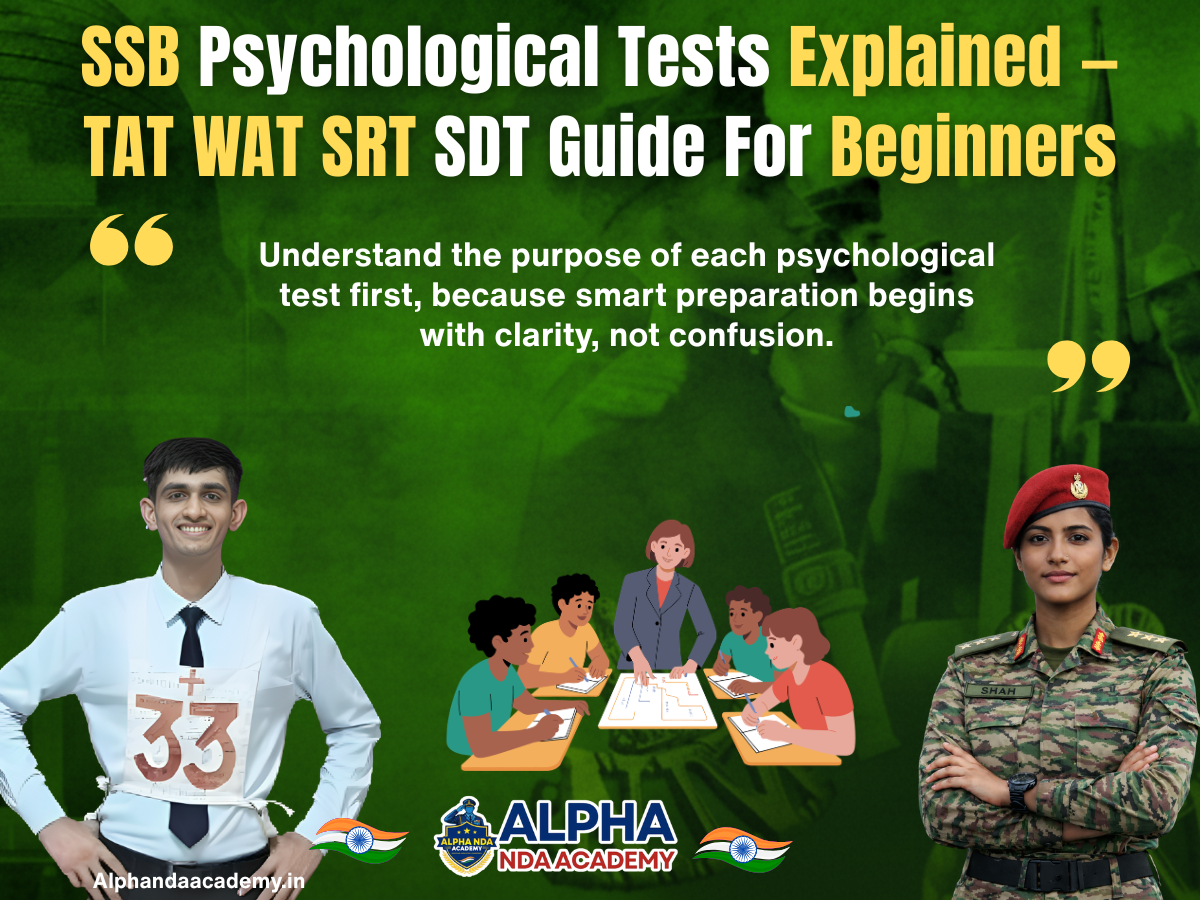
SSB psychological tests are designed to understand how a candidate thinks, reacts, imagines, decides, and sees himself or herself.
The psychologist does not look for fancy English or dramatic answers, but for natural responses that reflect responsibility, courage, planning, teamwork, and maturity.
In SSB, your personality is assessed through different techniques, and psychological testing is one of the most important parts.
It gives the assessors an idea of your inner personality because your answers are written under time pressure, where artificial answers are difficult to maintain.
The four major psychological tests are TAT, WAT, SRT, and SDT. TAT means Thematic Apperception Test, WAT means Word Association Test, SRT means Situation Reaction Test, and SDT means Self Description Test.
These tests are connected with your habits, thoughts, upbringing, daily behavior, confidence, and problem-solving approach.
This is why students preparing for SSB should work on personality improvement along with test practice.
Many NDA aspirants start SSB preparation only after clearing the written exam, but that can feel rushed.
Institutes like Alpha NDA Academy focus on building written preparation and personality awareness together, which helps students understand the SSB approach early and more naturally.
Why Psychological Tests Matter In SSB Interview
Psychological tests matter because they help assess your natural personality beyond spoken answers.
In an interview, a candidate may try to present himself in a polished way, but written psychological responses often show deeper thinking patterns.
The SSB does not expect a candidate to be perfect, but it does expect qualities suitable for a future officer.
These include practical intelligence, social adjustment, responsibility, initiative, confidence, determination, and emotional stability.
A candidate who writes realistic, positive, and action-based responses creates a better impression than someone who writes over-heroic or bookish answers.
The psychologist wants to see whether your thinking is balanced and whether you can act sensibly in different situations.
For example, if a situation involves helping an injured person, a mature answer will include quick assessment, safety, first aid, and arranging medical help.
A weak answer may simply say, “I will save him bravely,” without any practical steps.
This difference shows why preparation is not about memorising answers. It is about improving your thought process so your responses naturally become clear, responsible, and realistic.
What Is TAT In SSB Psychological Tests?
TAT, or Thematic Apperception Test, is a story-writing test based on pictures shown to the candidate.
You are shown a series of pictures, and you have to write a meaningful story around each picture within a limited time.
In TAT, the psychologist observes your imagination, attitude, problem-solving ability, social awareness, and leadership approach.
Your story usually reflects how you see challenges, people, goals, and outcomes in life.
A good TAT story has a central character, a clear situation, a practical problem, sensible action, and a positive result.
The hero should not be magical or unrealistic, but someone who thinks, plans, acts, and improves the situation.
For example, if the picture shows a student sitting near books, a natural story can be about planning studies, overcoming distraction, helping friends, or preparing for an important goal. The story should feel real and connected with normal life.
Avoid writing stories filled with accidents, death, crime, extreme sacrifice, or unnecessary drama unless the picture clearly suggests such a situation.
A balanced story shows hope, effort, teamwork, and practical action.
How To Write Better TAT Stories
To write better TAT stories, first observe the picture calmly and identify the main character. Then decide the background, the challenge, the action taken, and the final result in a simple and logical way.
Your story should move smoothly from problem to solution. The main character should take initiative, involve others if needed, use available resources, and bring a practical improvement.
Do not make every story about joining the army, saving the nation, or becoming a topper. Such repetition looks artificial because real life has many situations related to family, education, sports, society, leadership, health, discipline, and responsibility.
The hero of your story should be close to your own age and background whenever possible. This makes the story more natural and helps the psychologist connect your imagination with your personality.
Practice writing stories in simple English with clear actions. Good content matters more than ornamental language, so focus on clarity, realism, and positive effort.
What Is WAT In SSB Psychological Tests?
WAT, or Word Association Test, checks your immediate thought process through words. You are shown words one by one, and you have to write the first meaningful sentence that comes to your mind within a short time.
In WAT, your sentence should show your attitude, values, confidence, and practical mindset. The test is fast, so your natural thinking becomes more visible.
For example, if the word is “Failure,” a weak response may be “Failure is very bad.” A better response can be “Failure teaches a person to improve his method and try again.”
Similarly, for the word “Team,” a good response can be “A team succeeds when every member takes responsibility.” This shows cooperation, maturity, and result-oriented thinking.
Avoid writing quotes, definitions, or forced patriotic lines for every word. WAT is not a test of famous sayings; it is a test of your personal thinking.
How To Improve WAT Responses
To improve WAT responses, build a habit of positive and practical thinking in daily life. Your sentence should be short, meaningful, and action-oriented.
Do not convert every negative word into a fake positive sentence. Instead, show how a responsible person handles that situation with courage, learning, discipline, or patience.
For example, for “Fear,” do not write “Fear does not exist.” A more mature sentence is “Preparation and confidence help a person control fear.” This sounds realistic and balanced.
Practice common words related to life, duty, courage, study, family, society, time, success, anger, failure, pressure, and discipline.
But do not memorise fixed responses blindly because the psychologist can easily sense artificial patterns.
A good way is to read the word, think of a useful action, and write a complete sentence. Over time, your speed and quality both improve.
What Is SRT In SSB Psychological Tests?
SRT, or Situation Reaction Test, checks how you respond to real-life situations. You are given many situations, and you have to write what you would do in each case.
This test reveals your decision-making, courage, social sense, presence of mind, responsibility, and practical intelligence. The best answers are short, direct, and action-based.
For example, if the situation is that you see a road accident while going for an exam, a balanced response can be that you quickly inform emergency services, arrange nearby help, ensure the injured person gets assistance, and then proceed if possible.
The answer should not ignore duty, and it should not become unrealistic either. The psychologist wants to see whether you can manage pressure sensibly without panic.
SRT is close to real life, so candidates who observe daily situations carefully usually perform better. Your response should show that you act responsibly instead of blaming others or running away.
How To Answer SRT Smartly
To answer SRT smartly, write what you will actually do, not what sounds heroic. Your response should include quick assessment, practical action, use of available help, and completion of responsibility.
Avoid long explanations because time is limited. A short and complete response is better than a long answer that does not show clear action.
Do not write passive answers like “I will wait,” “I will inform my parents,” or “I will ask someone else” unless the situation genuinely requires it. Officers are expected to take initiative and handle responsibility.
At the same time, avoid reckless actions. Jumping into danger without thinking does not show courage; it may show poor judgment.
Good SRT practice builds mental alertness. It teaches you to think quickly, act logically, and stay calm in pressure situations.
What Is SDT In SSB Psychological Tests?
SDT, or Self Description Test, asks you to write about yourself from different viewpoints. Usually, you may have to describe what your parents, teachers, friends, and you yourself think about your personality.
This test checks self-awareness, honesty, maturity, and willingness to improve. It is not a place to praise yourself excessively or hide every weakness.
A good SDT answer presents your strengths naturally and mentions areas of improvement in a balanced way.
For example, you may write that your friends see you as helpful and disciplined, while you are working on improving public speaking or time management.
The psychologist checks whether your self-description matches your behavior in other tests. If your SDT says you are calm but your SRT answers show panic, the mismatch may create doubt.
That is why honesty is important. Write about qualities that are truly connected with your life and habits.
How To Prepare A Strong SDT
To prepare a strong SDT, first understand yourself clearly. Think about your strengths, weaknesses, daily habits, academic attitude, friendships, family behavior, and goals.
Ask your parents, teachers, and close friends how they genuinely see you. Their feedback can help you write a more natural and balanced self-description.
Do not write only perfect qualities like honest, hardworking, brave, intelligent, disciplined, and confident without any real depth. Add small practical details that make your description believable.
For example, instead of only saying “My teachers think I am hardworking,” you can write that your teachers appreciate your regularity and effort, but also advise you to participate more in discussions.
This kind of answer shows maturity because it accepts both appreciation and improvement. SSB looks for candidates who can grow, not candidates who pretend to be flawless.
Common Mistakes In SSB Psychological Tests
Many candidates make mistakes because they try to impress the psychologist instead of expressing their real personality.
This leads to artificial stories, copied WAT lines, unrealistic SRT answers, and over-polished SDT content.
Another common mistake is writing extreme responses. Some candidates turn every TAT story into a rescue mission and every WAT sentence into a motivational quote, which does not look natural.
Poor time management is also a major issue. If you think too much before writing, you may leave many answers incomplete, and incomplete responses reduce your overall performance.
Some students also ignore personality development and only practice test formats. But psychological tests are connected with your real habits, so daily discipline, reading, communication, physical fitness, and social awareness also matter.
Alpha NDA Academy often guides students to treat SSB preparation as a personality-building process, not just a test-writing exercise.
This approach is useful because SSB performance depends on both preparation and genuine personal development.
Best Preparation Tips For TAT WAT SRT SDT
The best preparation for TAT, WAT, SRT, and SDT starts with understanding the purpose of each test. Once you know what is being checked, your practice becomes more focused and meaningful.
Practice TAT by observing real-life situations and writing simple stories with a clear problem and solution. Keep your stories practical, positive, and connected with normal life.
For WAT, improve your thinking by reading good books, newspapers, biographies, and defence-related content. Better thoughts create better sentences under time pressure.
For SRT, observe how responsible people react in daily situations. Learn to think in steps: understand the issue, act quickly, use help, and complete the task.
For SDT, work on self-awareness. Write your self-description, revise it honestly, and make sure it reflects your real personality rather than a copied sample.
How Alpha NDA Academy Helps In SSB Preparation
Alpha NDA Academy helps students understand that NDA preparation does not end with the written exam.
A serious aspirant must also develop confidence, communication, discipline, physical fitness, and awareness for SSB.
For psychological tests, guided practice can make a big difference because students often do not know whether their answers are natural or artificial.
Proper feedback helps them correct mistakes and build better response patterns.
At Alpha NDA Academy, the focus is not only on teaching formats but also on shaping the mindset required for defence selection.
Students learn how to think clearly, respond practically, and present their personality with honesty.
This kind of guidance is especially helpful for young aspirants who are preparing after 10th, 11th, or 12th.
Early exposure to SSB concepts gives them time to improve gradually instead of rushing at the last moment.
A good academy does not create fake personalities. It helps students discover their strengths, reduce weaknesses, and express themselves better during the selection process.
Final Thoughts
SSB Psychological Tests Explained — TAT WAT SRT SDT Guide helps aspirants understand that these tests are not meant to confuse them.
They are designed to assess natural thinking, practical action, emotional balance, and officer-like qualities.
TAT checks your imagination and problem-solving through stories, WAT checks your quick thought process, SRT checks your reaction in real situations, and SDT checks your self-awareness. Together, these tests create a deeper picture of your personality.
The best way to prepare is to stay honest, practice regularly, improve daily habits, and avoid copied answers. A candidate who thinks clearly, acts responsibly, and keeps improving naturally performs better in psychological testing.
With the right guidance from mentors and institutes like Alpha NDA Academy, students can prepare for both NDA written and SSB interview in a more balanced way.
The real takeaway is simple: build your personality, understand the tests, and express your true potential with confidence.
FAQs
What Are SSB Psychological Tests In TAT WAT SRT SDT?
Alpha NDA Academy explains SSB psychological tests as personality-based assessments that check a candidate’s thinking, reactions, imagination, and self-awareness. TAT, WAT, SRT, and SDT help psychologists understand officer-like qualities such as responsibility, courage, planning, teamwork, emotional balance, and practical decision-making.
Why Are Psychological Tests Important In SSB?
Psychological tests are important in SSB because they reveal a candidate’s natural personality under time pressure. These tests help assess whether the aspirant can think clearly, act responsibly, handle stress, and show qualities expected from a future defence officer.
How Is TAT Conducted In SSB Psychology Test?
TAT is conducted by showing candidates pictures and asking them to write stories within a limited time. A good TAT story includes a main character, a realistic situation, a problem, sensible action, and a positive outcome that reflects maturity and practical thinking.
What Is The Best Way To Prepare For WAT?
The best way to prepare for WAT is to practice quick, meaningful, and positive sentence formation. Candidates should avoid memorised quotes and instead write natural responses that show confidence, discipline, responsibility, and a balanced attitude toward real-life situations.
How Should Candidates Answer SRT In SSB?
Candidates should answer SRT with short, practical, and action-based responses. The answer should show presence of mind, courage, responsibility, and logical decision-making. Alpha NDA coaching often guides students to avoid over-heroic answers and focus on realistic officer-like reactions.
What Should Be Written In SDT?
SDT should include honest views about yourself from parents, teachers, friends, and your own perspective. A strong Self Description Test answer highlights real strengths, accepts areas of improvement, and shows that the candidate is self-aware, mature, and willing to grow.
Can SSB Psychological Tests Be Prepared In Advance?
Yes, SSB psychological tests can be prepared in advance through regular practice and personality development. Candidates should understand each test format, improve daily habits, read good content, observe real situations, and take structured feedback from mentors or institutes like Alpha NDA Academy.
Are SSB Psychological Tests Difficult For First-Time Candidates?
SSB psychological tests can feel difficult for first-time candidates because they are time-bound and personality-based. However, with proper understanding of TAT, WAT, SRT, and SDT, students can respond more naturally and confidently instead of depending on memorised answers.
How Much Time Is Needed To Prepare TAT WAT SRT SDT?
Most candidates need consistent practice for a few weeks to understand TAT, WAT, SRT, and SDT properly. The exact time depends on the student’s confidence, writing speed, self-awareness, and ability to think practically under pressure.
What Mistakes Should Be Avoided In SSB Psychology Tests?
Candidates should avoid copied answers, unrealistic stories, over-dramatic reactions, negative thinking, and incomplete responses. The safest approach is to write naturally, stay practical, show responsibility, and ensure answers match your real personality and officer-like qualities.