How to Write Good TAT Stories for SSB Complete Guide for NDA Aspirants?
How to Write Good TAT Stories for SSB Complete Guide for NDA Aspirants?
We have seen hundreds of students walk into SSB well-prepared for the written exam but completely confused when it comes to the Thematic Apperception Test popularly known as TAT. Most of them know the name. Very few understand what it actually tests. And even fewer know how to write a TAT story that genuinely reflects good OLQs.
That confusion costs them. And we don’t want it to cost you.
This guide is written from our real experience of training students at Alpha NDA Academy for SSB. We’ll break down everything about TAT in the simplest possible way what it is, how to structure your story, what to avoid, and how to practice from today.
If you haven’t read our guide on SSB Psychological Tests Explained yet, we recommend starting there first. It covers TAT, WAT, SRT, and SDT together. Once you finish that, come back here for a deeper dive into TAT specifically.
What Is TAT in SSB And Why Does It Matter?
TAT stands for Thematic Apperception Test. It is one of the four major psychological tests conducted on Day 2 of the SSB interview.
In TAT, you are shown a series of pictures one at a time. Each picture is slightly hazy, unclear, or open to interpretation. After looking at a picture for about 30 seconds, you are given roughly 4 minutes to write a story based on what you saw.
In total, you write 12 stories. The first 11 are based on 11 different pictures. The 12th story is based on a blank slide meaning you have to create a story from your imagination with no image at all.
Now here is the important thing most students miss. The psychologist is not reading your stories to check your English or your handwriting. They are reading to understand who you are as a person. What kind of situations do you imagine? How does your hero react? Does your character show responsibility, planning, leadership, and a positive approach? Or does he stay passive, depend on others, and land in trouble?
Your story is a mirror of your personality. That is why TAT matters deeply in SSB selection.
You can also read our detailed breakdown of what actually happens during the SSB interview’s 5-day process to understand where TAT fits in the overall schedule.
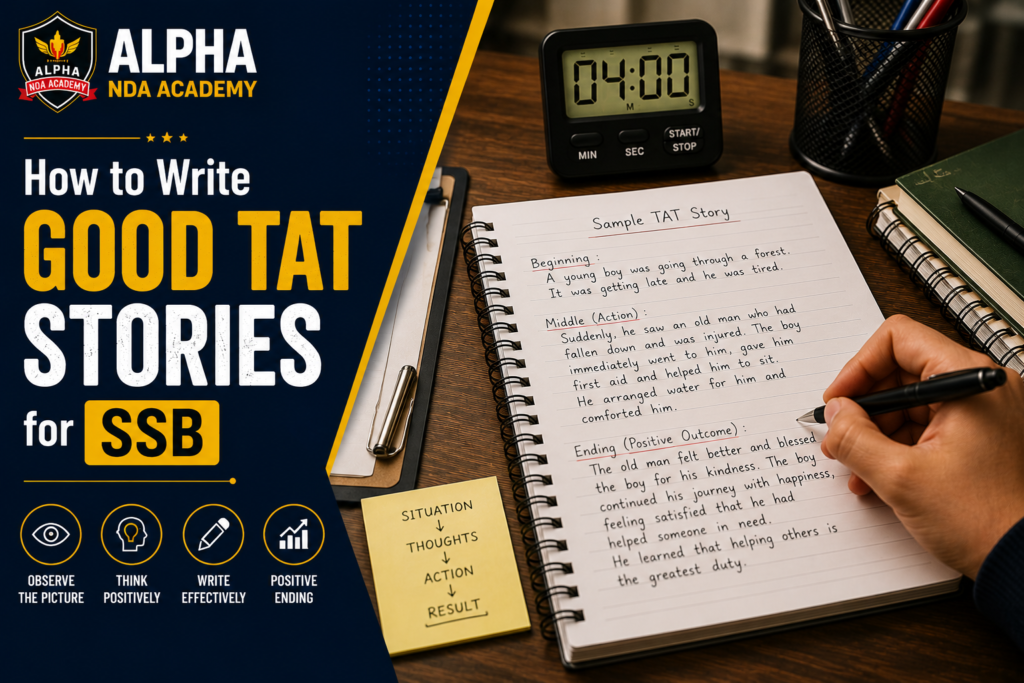
The 4-Part Structure That Every Good TAT Story Must Follow
One of the most common questions we get from students is “How long should a TAT story be and what should it include?”
The answer is simple. Every TAT story should have four clear parts. If any part is missing, the story feels incomplete and the psychologist may not get a clear picture of your personality.
Here is the structure we teach at Alpha NDA Academy:
Part 1 The Background (Lead-In)
In 2 to 3 lines, set the context. Who is the main character? What is he doing? Where is he? Keep this short and quick. Many students waste too much time on background and then rush the rest of the story.
Example: Rahul is a 19-year-old student preparing for his NDA exam. One evening, he comes to know that a fire has broken out in a nearby building.
Part 2 The Problem or Situation
This is the central challenge or situation in your story. It can be a fire, a natural disaster, a team problem, a moral decision, a medical emergency, or anything that needs action. The picture shown to you will give you a hint about this.
Example: The residents of the building are panicking. There is no fire brigade nearby and smoke is spreading rapidly to the upper floors.
Part 3 The Action of the Hero
This is the most important part. Your hero the main character must take clear, positive, and decisive action. This is where your OLQs show up. Does he panic or does he plan? Does he wait for someone else or does he lead? Does he give up or does he keep going?
Write 4 to 5 lines on what the hero does. Be specific. Show planning, courage, and teamwork.
Example: Without wasting time, Rahul organizes the residents and forms a chain to pass wet towels and buckets of water. He assigns two people to call the fire brigade and two others to guide the elderly down the stairs safely. He himself goes to the top floor to check for any trapped residents.
Part 4 The Positive Outcome
Always end with a positive and practical result. The hero does not have to perform a miracle. But the story must end well even if imperfectly. Avoid deaths, accidents, or tragic endings.
Example: The fire brigade arrives and puts out the fire quickly. The building is evacuated safely and no one is seriously hurt. Rahul receives appreciation from the residents for his calm response in a difficult situation.
That’s a complete, well-structured TAT story. Not dramatic. Not filmy. Just real, clear, and action-oriented.
What Kind of Hero Should Appear in Your TAT Stories?
This is something we tell every student during SSB preparation at Alpha NDA Academy your hero is a version of you.
The hero in your story should ideally be:
Close to your age If you are 17 or 18, the main character should ideally be between 17 and 22 years old. Do not always write stories about 40-year-old officers or experienced professionals.
A student, cadet, or young person The psychologist understands that you are young. Your stories do not need a retired colonel saving the day. A regular student who shows leadership is far more relatable and convincing.
Positively motivated Your hero should act not for fame or reward, but because it is the right thing to do.
Balanced in his approach He should be confident but not overconfident. Decisive but not reckless. Helpful but not helpless.
The psychologist compares all 12 stories you write. If your hero is always a superhero who does everything alone, that raises a flag. If your hero always waits for someone else to act, that also raises a flag. The best stories show a balanced, practical, responsible young person.
7 Rules We Follow at Alpha NDA Academy for Strong TAT Stories
After working with thousands of NDA and SSB aspirants across Rajasthan and India, these are the 7 rules that separate strong TAT stories from weak ones:
Rule 1 Keep your hero active, not reactive.
Your hero should initiate action. He should not wait for someone to tell him what to do. This shows initiative one of the key OLQs.
Rule 2 Write in simple, clear English.
You do not need complex sentences. Short, clear sentences written fast are far better than long, confused paragraphs. The psychologist values clarity over sophistication.
Rule 3 Avoid tragic endings at all costs.
Stories that end with death, failure, or sadness leave a negative impression. Even if the situation is dangerous, your hero must find a way to a positive or constructive outcome.
Rule 4 Do not repeat the same theme across stories.
If your first story is about a fire, your second story should not also be about a fire. Vary your themes natural disasters, academic challenges, social issues, medical emergencies, teamwork at a camp, helping a junior the range shows a broad personality.
Rule 5 Give your hero a name.
This small habit keeps the story personal and connected. Instead of writing “the boy” or “he” throughout, give the character a name. It also helps you write faster.
Rule 6 Stick to realistic situations.
Your hero should not single-handedly stop a terrorist attack or defuse a bomb. Keep situations grounded in real life. A good TAT story feels like something that could actually happen.
Rule 7 Manage your time strictly.
You have roughly 4 minutes. In our SSB preparation sessions, we train students to write 12 to 15 lines in that time not too short (which looks rushed) and not too long (which causes them to miss later stories). 12 to 14 lines is usually the sweet spot.
A Sample TAT Story With Our Notes
Here is a sample picture situation and how a student might approach it. Imagine the picture shows a young person standing near a field with some farming tools visible in the background and another figure lying on the ground.
Weak version (what NOT to write):
Suresh saw a man lying on the ground. He felt bad. He did not know what to do. He waited for someone to come. After some time an ambulance came and the man was saved. Suresh went home.
Strong version (what you SHOULD write):
Rajan, an 18-year-old student from a nearby village, was crossing a field after school when he noticed an elderly farmer lying unconscious near a well. Without panic, Rajan first checked if the man was breathing, then ran to the nearest road and stopped a passing vehicle for help. He directed two local workers to carefully carry the man to the shade and used his phone to call for an ambulance. He also contacted the farmer’s family. The ambulance arrived within 15 minutes and the farmer was rushed to the district hospital. The farmer later recovered fully. Rajan’s quick thinking and calm presence ensured a life was saved in time.
Notice the difference. The second story shows initiative, planning, communication, teamwork, and presence of mind all without being unrealistic.
The Blank Picture The Most Underestimated Slide in TAT
Most students think the 12th slide the blank one is a bonus or an easy round. We disagree completely.
The blank picture is one of the most revealing parts of TAT. When there is no image to guide you, your mind creates the story entirely from your own imagination. And that imagination tells the psychologist a great deal about your natural thinking patterns.
Here is what we suggest for the blank picture:
Write a completely different theme from your previous 11 stories. Since you have been reacting to pictures until now, this is your one chance to show a theme you genuinely care about service, innovation, social responsibility, national contribution.
Give it your best structure background, problem, action, positive outcome just like every other story.
Make the hero someone relatable and the situation meaningful. A story about a cadet organizing a flood relief effort or a student starting a community initiative works very well.
Do not write something dramatic just because there is no picture to restrict you. Stay grounded.
Common Mistakes That Can Hurt Your TAT Score
We see these mistakes repeatedly from students who have not had structured SSB training:
Writing too few lines A 5 or 6-line story looks rushed and shows you ran out of ideas. Aim for at least 12 solid lines.
Writing a story that describes the picture instead of building a plot If the picture shows two people sitting, do not just write “Two people are sitting and talking.” Give them a purpose, a challenge, and an action.
Mixing Hindi words in the story Write entirely in English during the psychology tests. You can speak Hindi in the personal interview or GD if comfortable, but written tests should be in English.
Making the hero too perfect If the hero never makes any mistake or never faces a real challenge, it feels fake. Add small struggles that the hero overcomes.
Ending abruptly If you run out of time, still write a one-line ending. “He completed the mission successfully” is better than no ending at all.
Copying the picture too literally The psychologist is not checking if your story matches the image exactly. The image is just a starting point. Build beyond it.
All of these are things we work on with students during our SSB preparation program. For details on our structured SSB program, you can visit our SSB Interview Guidance Program page.
What OLQs Does TAT Evaluate?
OLQs Officer Like Qualities are the set of personality traits that the Services Selection Board looks for in every candidate. TAT is one of the most powerful tools to assess these qualities because you cannot fake 12 stories consistently.
The major OLQs that show up in a good TAT story include:
Effective Intelligence Does the hero identify the real problem and find a smart solution?
Courage Does the hero take action even in a risky or uncomfortable situation?
Initiative Does the hero act without being told, or does he always wait for orders?
Sense of Responsibility: Does the hero care for others and take ownership of the situation?
Cooperation and Teamwork: Does the hero work with others or does he always act alone?
Speed of Decision: Does the hero decide quickly and act, or does he stay confused for too long?
Determination: Does: the hero keep going when things get difficult?
When you write 12 stories, the psychologist sees a pattern across all of them. That pattern reveals your natural personality far more honestly than any interview answer ever could.
How to Practice TAT on Your Own Starting from Today
You don’t need to wait for SSB to start building your TAT skills. Here is a simple daily practice routine that we recommend:
Spend 15 minutes each evening practicing one TAT story. You can use random Google images or describe scenes from your surroundings as your starting picture.
Time yourself strictly. 30 seconds to observe the picture or scenario. Then 4 minutes to write. Stop when the timer rings.
Write by hand not on a phone or laptop. SSB is written, and your hand needs to be fast and comfortable.
Use a notebook dedicated to TAT practice. After every 5 stories, review them. Check if the hero is always active, if the theme is positive, and if all 4 parts are present.
Ask a senior or mentor to review your stories once a week. At Alpha NDA Academy, this is built into our daily SSB preparation routine students practice TAT in structured batches and get personal feedback from our mentors.
Also read our blog on when SSB preparation should start to understand how to build TAT practice into your overall timeline.
How TAT Connects to the Rest of SSB Psychology
TAT does not work in isolation. The psychologist cross-checks your TAT responses with your WAT (Word Association Test), SRT (Situation Reaction Test), and SDT (Self Description Test). If the values and personality that show up in your TAT are very different from your WAT or SRT, that inconsistency will get noticed.
For example, if your TAT stories show a hero who is helpful and cooperative, but your SRT answers show someone who acts impulsively and ignores others those don’t match. The psychologist will pick this up.
This is why personality development is not something you can shortcut. It is not about memorizing the right answers. It is about actually becoming the kind of person whose natural responses align with OLQs.
Read our detailed guide on SSB Screening Test and PPDT and the SSB Word Association Test to understand how all psychology tests connect with each other.
You can also go through our SSB Situation Reaction Test practice guide to practice SRT alongside TAT for a more complete preparation.
What We Teach About TAT at Alpha NDA Academy
At Alpha NDA Academy in Sikar, Rajasthan, we do not treat SSB preparation as something that begins after the written exam. SSB coaching starts from Day 1 of your joining and TAT practice is part of that routine from the very beginning.
Our students practice TAT in timed conditions every week. Each story is reviewed by our mentors not just for structure, but for the OLQs that emerge from the storyline. Students receive individual feedback, and common errors are corrected in group sessions so everyone learns from each other’s mistakes.
We also run mock psychology days where students go through TAT, WAT, SRT, and SDT back to back exactly the way it happens in real SSB. This kind of practice builds speed, comfort, and natural response patterns.
If you’re seriously considering SSB preparation, check out our SSB Interview Guidance Program it is designed specifically for students who want structured, expert-led preparation for every stage of the 5-day SSB process.
For students who have just cleared the NDA written exam and are looking for SSB guidance, we also offer a 25-day complete SSB coaching free of cost for all written-qualified students enrolled in our programs.
You can also read our guide on what happens after the NDA written exam to understand your next steps clearly.
Frequently Asked Questions About TAT in SSB
How many pictures are shown in TAT?
There are 12 situations in TAT 11 actual pictures and 1 blank slide. You write one story for each, totalling 12 stories.
How much time do you get per story in TAT?
Each picture is shown for approximately 30 seconds. After that, you get roughly 4 minutes to write your story.
Can I write a story where the hero fails?
Technically there is no rule against it, but we strongly advise against it. A story that ends in failure or tragedy does not reflect the positive, determined mindset SSB is looking for. Always aim for a constructive or positive ending.
Do I need to write in very good English?
No. Clear, simple English is enough. What matters is the content of the story the situation, the hero’s action, and the outcome not the vocabulary or grammar level.
Can the hero be a girl?
Yes, absolutely. Girl candidates should absolutely write stories with female protagonists. Male candidates may occasionally vary the protagonist gender too, but the key is that the story feels natural and not forced.
What if I cannot understand the picture clearly?
That is completely normal. TAT pictures are intentionally hazy or unclear. You are expected to interpret them as you see them. There is no single correct interpretation. Go with your first instinct and build a story around it.
Is TAT the most important psychology test?
All four psychology tests TAT, WAT, SRT, and SDT are important. TAT is considered one of the most revealing because it allows more detailed storytelling. But all four together paint the complete psychological picture.
How do I practice TAT at home?
Use any image a newspaper photograph, a scene from a book, or even a description of what you see around you. Set a 30-second observation time and a 4-minute writing time. Write by hand. Review each story for structure and OLQ reflection.
A Few Last Words Before You Begin
TAT is not a test you can crack by memorizing answers. You cannot search for “best TAT stories for SSB” and reproduce them in the interview room. The psychologist is trained to detect artificial, rehearsed patterns and that actually hurts more than a naturally written story with some flaws.
What you can do is practice genuinely. Write stories that reflect how you actually think. Work on becoming a better, more balanced, more responsible version of yourself and your TAT stories will reflect that automatically.
Start now. Even before you clear the NDA written. Because the student who spends 6 months becoming a better thinker, a calmer planner, and a more responsible person will always write better TAT stories than a student who spends one week memorizing a list.
If you want to understand the complete NDA journey from written exam to SSB, go through our NDA Selection Process guide for a clear picture of every step ahead.
And if you want structured preparation that covers both NDA written and complete SSB training from Day 1 connect with us at Alpha NDA Academy. Our mentors are here to guide you.