SSB Chest Number Allotment What It Means and Everything a First Time Candidate Must Know
SSB Chest Number Allotment What It Means and Everything a First Time Candidate Must Know
We have spoken to hundreds of students over the years at Alpha NDA Academy who cleared the NDA written exam, got their SSB call letter, and then came to us with one simple question.
“Sir, what exactly is this chest number? What do I do with it? Does it matter?”
It is one of the most common questions we hear from first time SSB candidates. And honestly, it is a fair question. Nobody tells you about it clearly. The call letter mentions it briefly. Some YouTube videos touch on it. But very few places explain what it actually means, how it works, and why the entire SSB system is built around it.
That is what this blog is for.
We are going to explain SSB chest number allotment from scratch. Simple, clear, and complete. If you are going to SSB for the first time or if you are in Class 10, 11, or 12 and are preparing for NDA, read this carefully. By the end of this blog, you will understand exactly what the chest number is, when you get it, how it is used across all five days, and what you should keep in mind.
Let us start from the very beginning.
What Is the SSB Chest Number?
Think of it this way.
When you report to the SSB centre, you are one among many candidates who have all come together at the same time. In a typical SSB batch, there can be anywhere from 30 to 60 candidates or sometimes more, depending on the entry and the centre.
Now, the assessors at the SSB centre cannot call each of you by your name. That would create bias. An assessor might know someone personally, or might recognise a name, or might have some prior impression of a candidate based on background. To prevent all of this, the SSB system does something very smart.
Every candidate is assigned a unique number on the first day. This number is your identity for the entire duration of the SSB process. You wear this number on your chest throughout all five days. That is why it is called the chest number.
From the moment you receive your chest number until the final conference on the last day, the assessors do not refer to you by your name. They observe you, record their findings, and file all reports using your chest number.
Your name becomes secondary. Your chest number becomes your primary identity at SSB.
When Is the Chest Number Given?
This is something many students are unsure about, and we want to clear it up completely.
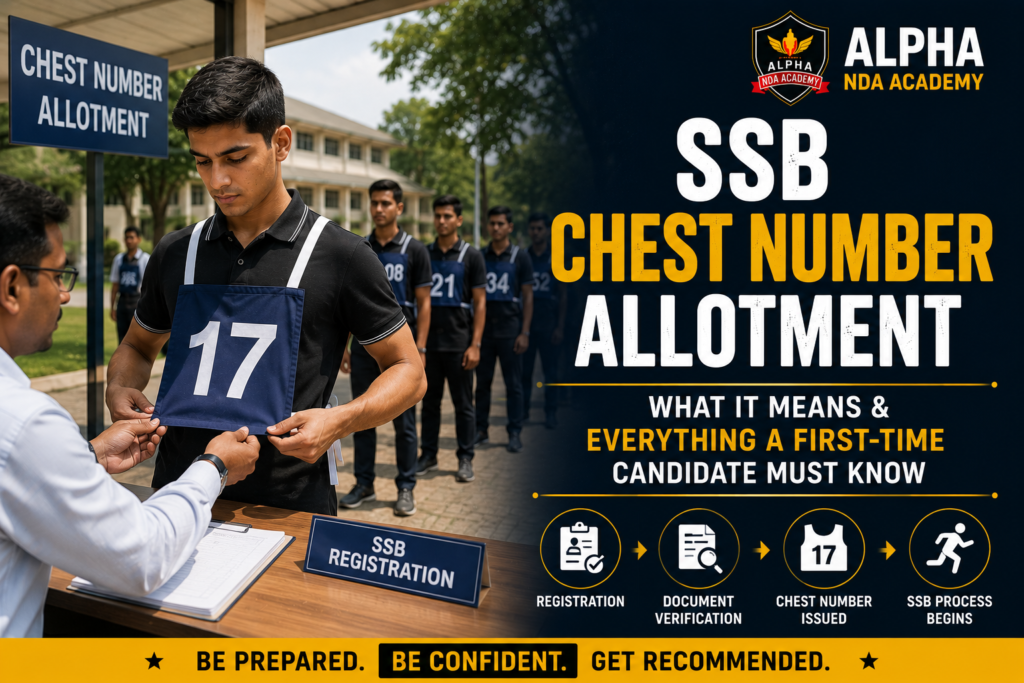
When you arrive at the SSB centre on the reporting day (which most people call Day 0 or the arrival day), you go through a set of formalities. These include document verification, signing in at the reception, submitting your SSB call letter and required documents, and getting settled in the accommodation provided.
After these initial formalities are complete, each candidate is given a chest number. This usually happens during a brief introductory session where all candidates are gathered together and numbered.
The chest number is typically written on a small card or board that you wear around your neck or pin on to your shirt or uniform throughout the process. Some centres provide a lanyard with the number. Some provide a tag. The format can vary slightly from centre to centre, but the purpose is exactly the same everywhere.
Once your chest number is assigned, it stays with you for all five days of the process. You do not get a new number on Day 2 or Day 3. The same number follows you from screening on Day 1 all the way to conference on Day 5.
Important point: Memorise your chest number the moment you receive it. You will need to know it instantly and confidently whenever asked. Forgetting your own chest number, even for a moment, can create unnecessary confusion and leave a poor impression.
How Are Chest Numbers Assigned? Is It Based on Merit or Random?
This is a very common doubt, especially among students who hear things like “lower numbers are luckier” or “odd numbers are better.” Let us be very direct about this.
Chest numbers are assigned based on reporting order in most SSB centres. The candidate who reports and completes formalities first gets Number 1. The next candidate gets Number 2, and so on. In some cases, it may be done alphabetically based on surnames. The exact method can vary slightly by centre, but one thing is absolutely certain.
There is no merit or ranking in chest number assignment. Getting Number 1 does not mean you are the best candidate or the first priority. Getting Number 45 does not mean you have a disadvantage.
The chest number is purely an identification tool. Nothing more. We have seen students at Alpha NDA Academy stress over which chest number they received, and we always tell them the same thing. It makes zero difference to your assessment or your result.
Why Does the SSB System Use Chest Numbers?
This is the part that most blogs skip, but we think it is important for you to understand because it helps you respect the system and work within it better.
The SSB selection process is built on objectivity. The goal of the five days is to assess your true personality, your natural leadership qualities, your communication, your decision making, your teamwork, and your ability to handle pressure. All of this needs to be assessed fairly, without any bias.
If assessors knew your name, your background, your father’s profession, or your city, it could unconsciously influence their observations. Maybe a candidate has a very well known surname. Maybe an assessor has heard of the candidate’s school. These things can create unconscious bias even when assessors are trying to be fair.
The chest number system removes all of this. When an assessor watches the Group Task round and makes notes, they write “Chest Number 12 showed leadership in the outdoor task” instead of “Ramesh from Delhi showed leadership.” This protects the integrity of the entire selection system.
At Alpha NDA Academy, we always tell our students this: the chest number system is not just a formality. It is a proof that SSB is one of the most professionally designed selection processes in the world. Understanding this helps you trust the system and focus on showing your genuine qualities rather than worrying about impressing someone personally.
To understand how this fits into the complete five day SSB process, read: SSB Interview 5 Day Process Explained for First Time Candidates
How the Chest Number Is Used Across All Five Days
Now let us walk through each stage of SSB and explain exactly how your chest number comes into play. This will help you understand the full picture.
Day 1: Screening (OIR Test and PPDT)
On Day 1, candidates appear for the Officer Intelligence Rating test and the Picture Perception and Discussion Test. These two stages are used to screen candidates and decide who proceeds to the full five day process.
When you sit in the examination hall for the OIR test, your chest number is written at the top of your answer sheet. The assessors identify your OIR performance by your chest number, not your name.
During the PPDT, when candidates discuss their stories in a group, assessors observe each candidate and take notes using chest numbers. If Chest Number 7 spoke clearly and showed a logical approach, that is noted against Chest Number 7.
After the results are declared, screened in candidates are called by their chest numbers. This is one of the most exciting and tense moments of SSB. You hear numbers being called out and you wait for yours.
To understand what exactly happens during this day: SSB Screening Test and PPDT Explained
Days 2 and 3: Psychology Tests and GTO Tasks
Candidates who are screened in continue to Day 2 and Day 3.
During the psychology tests on Day 2 (which include the Thematic Apperception Test, Word Association Test, Situation Reaction Test, and Self Description Test), all your answer booklets are identified by your chest number. The psychologist who analyses your responses does so without knowing your name. They only know your chest number.
During the Group Testing Officer tasks on Days 2 and 3, your chest number is on your chest visibly at all times. The GTO observes multiple candidates performing outdoor and indoor tasks simultaneously and takes notes using chest numbers. After each task, the GTO knows which chest number showed initiative, which one communicated well, and which one struggled with a specific activity.
Your chest number during GTO tasks is literally the most important thing you are wearing. Make sure it is visible, not covered by clothing, and is not damaged or fallen off.
For complete details on GTO tasks: SSB GTO Tasks Explained
Day 4: Personal Interview
During the personal interview, the interviewing officer finally meets you face to face for a longer, more personal conversation. Here, the officer does know your name because a personal conversation requires that natural human interaction.
However, even during the personal interview, your chest number is noted on your interview file. All the information from your psychology report, your GTO observations, and your OIR performance that has been compiled so far is linked to your chest number. The interviewing officer has access to your file through your chest number identification.
For preparation tips for this stage: SSB Personal Interview Most Asked Questions
Day 5: Conference
The conference is the final stage where all three assessors (psychologist, GTO, and interviewing officer) sit together and discuss each candidate. The entire discussion in the conference room happens using chest numbers. The assessors share their individual observations and come to a final decision about whether the candidate is recommended or not.
When results are announced after the conference, chest numbers are again called out. If your chest number is among those called, you have been recommended.
For a detailed explanation of the conference day: SSB Conference Day What Happens and How to Face It
What Happens If You Lose Your Chest Number Tag?
This is a practical concern that first time candidates sometimes do not think about until it happens.
If the tag or card with your chest number gets damaged, falls off, or becomes unreadable, inform the SSB staff immediately. They will provide you with a replacement. Do not try to handle it quietly or assume it does not matter.
Your chest number tag must be visible and readable at all times during tasks and activities. If an assessor cannot read your number during a group task because it is tucked inside your shirt, they might miss observing your contributions accurately. That is a loss for you.
Simple tip from our experience at Alpha NDA Academy: Use a safety pin to secure your chest number tag properly on the first morning itself. Check it before every activity. Some candidates use an extra pin to make sure it does not swing around and become unreadable.
Common Myths About SSB Chest Numbers (That We Hear From Students)
Over the years, we have heard some genuinely surprising myths that students believe about chest numbers. Let us clear all of them right here.
Myth 1: Low numbers like 1, 2, or 3 get more attention from assessors.
This is completely false. Assessors observe all candidates with equal attention. Your chest number has no relation to how much attention you receive.
Myth 2: If two candidates have numbers close together, assessors compare them against each other.
This is also false. SSB assessors evaluate every candidate against a standard set of qualities called Officer Like Qualities. They do not rank Chest Number 4 against Chest Number 5. Each candidate is assessed individually on their own merit.
Myth 3: Chest numbers are assigned based on written exam rank.
This is incorrect. As we explained earlier, chest numbers are assigned based on reporting order or alphabetical order at the centre. They have nothing to do with your NDA or written exam rank.
Myth 4: If a candidate with a nearby chest number performs badly, it affects your evaluation.
Completely false. Your performance is recorded and evaluated independently. Someone else’s poor performance has no negative impact on how you are assessed.
What First Time SSB Candidates Often Miss at the Reporting Stage
The chest number is given at the very start, during the reporting and document verification stage. This is a moment when many first time candidates are anxious, distracted, and overwhelmed.
We have had students come back and tell us they were so nervous during reporting that they almost forgot their chest number by the time the first activity started.
Here is what we tell every student at Alpha NDA Academy before they go for SSB.
When you receive your chest number, write it down on a small piece of paper and keep it safely in your pocket as a backup. Say the number out loud to yourself a few times. Get comfortable with it. That number is you for the next five days.
Also, make sure all your documents are in order before you even reach the SSB centre. A smooth reporting process means you can focus on what matters instead of running around for paperwork.
For a complete document checklist before you report: Documents Required for SSB Interview 2026
How This Fits Into Your Bigger NDA and SSB Journey
Understanding the chest number allotment is just one small but important piece of knowing how SSB works.
The bigger picture is this: after you clear the NDA written exam, you get an SSB call letter. You report to the allotted centre. You receive your chest number. The five day assessment begins. If you are recommended at the end of Day 5, you go for medical examination. After clearing medical, your name appears in the final merit list. And then your journey to the National Defence Academy begins.
Knowing each step of this process removes the fear and replaces it with clarity.
For the full picture of what happens after the written exam: What Happens After NDA Written Exam
And for the complete NDA selection process from exam to joining: NDA Selection Process Explained
If you want to understand how much time you typically get between written exam result and SSB reporting: How Much Time Is Given for SSB After Written Exam for NDA Aspirants
How Alpha NDA Academy Prepares Students for SSB Reporting and the Full Process
At Alpha NDA Academy, we believe that SSB preparation does not start when the call letter arrives. It starts from Day 1 of coaching.
The qualities that SSB assessors look for, including leadership, communication, group contribution, problem solving, and mental stability, are all developed over months of consistent preparation. They cannot be built in 30 days before the SSB interview.
Here is how we prepare our students for SSB at Alpha NDA Academy:
SSB Orientation Sessions: We explain the full five day process, including chest number allotment, reporting procedures, document preparation, and what each day involves. Students know exactly what to expect before they step foot in the SSB centre.
Mock SSB Activities: We conduct regular mock GTO tasks, group discussions, and psychology practice sessions so students are not experiencing these activities for the first time at the actual SSB centre.
PIQ Form Guidance: The Personal Information Questionnaire is a critical document submitted at SSB. We help students fill it correctly and prepare their answers in a way that reflects their genuine personality.
Personal Interview Practice: Our faculty conducts mock personal interviews with each student so they are comfortable with face to face evaluation. We also work on language, clarity, and confidence.
SSB Personality Development: We run structured personality development sessions covering topics like current affairs, leadership scenarios, group dynamics, and self expression. These sessions are specifically designed around the Officer Like Qualities that SSB assesses.
At Alpha NDA Academy, we offer multiple programme options for students who want structured SSB and NDA preparation:
NDA Foundation After 10th (Arjuna Batch) gives students 2 full years to build the written preparation and SSB personality together. This is the most time rich option and gives the highest conversion rate.
NDA With 12th Class (Bulls Eye Batch) balances Class 12 board preparation with NDA written and SSB coaching so students are ready on both fronts simultaneously.
NDA After 12th (Spartans Batch) is our one year intensive programme for students who have completed Class 12 and want focused, complete NDA and SSB preparation.
NDA Coaching for Girls is a dedicated programme for female aspirants preparing for NDA with separate facilities and specialised SSB training.
SSB Interview Guidance Programme is specifically for candidates who have already cleared the NDA written exam and need focused SSB preparation before they report to the centre.
Call us at 7240040400 or WhatsApp us at wa.me/917240040400 to speak with our team and understand which programme is right for you.
FAQs About SSB Chest Number Allotment
Q1. What is a chest number in SSB?
– A chest number is a unique identification number assigned to each candidate when they report to the SSB centre. It is worn on the chest throughout all five days of the SSB process and replaces your name for the purpose of assessment and evaluation.
Q2. When do you get your chest number at SSB?
– The chest number is typically given on the reporting day, after document verification and initial formalities are completed. This happens before Day 1 activities like OIR and PPDT begin.
Q3. How is the chest number assigned?
– Chest numbers are usually assigned based on the order in which candidates complete their reporting and document verification formalities. Some centres may use alphabetical order. There is no merit or written exam rank involved in the assignment.
Q4. Does chest number affect your evaluation at SSB?
– No. The chest number is purely an identification tool. Whether you are Number 1 or Number 50 has absolutely no impact on how assessors evaluate your performance.
Q5. What should I do if my chest number tag falls off during an activity?
– Inform the SSB staff immediately and request a replacement. Always secure your chest number tag firmly with a safety pin on the first morning to prevent this situation.
Q6. Can I find out my chest number before I reach the SSB centre?
– No. Chest numbers are assigned on the reporting day itself at the SSB centre. You cannot know your number in advance.
Q7. Is the chest number the same for all five days?
– Yes. The chest number assigned to you on Day 0 or Day 1 morning stays with you throughout the entire five day process. You do not receive a new number on any day.
Q8. Is the chest number the same as the roll number on the call letter?
– No. The roll number on your SSB call letter is your reference number for scheduling and centre allocation. The chest number is a separate number given at the centre itself during reporting.
Final Thought: Small Details Make Big Differences
The chest number is a small thing. A card with a number on it. But understanding what it represents, how it works, and what it means for your evaluation at SSB is part of being a well prepared candidate.
The Indian Armed Forces selection system is one of the most thorough and fair assessment systems in the world. The chest number is a reflection of that fairness. It ensures that every candidate is evaluated on their actual qualities and nothing else.
As a candidate, your job is simple. Know your number. Wear it visibly. Perform genuinely across all five days. Let your qualities speak for themselves.
And if you want a coaching programme that prepares you for every step of this journey, from the NDA written exam to SSB reporting to the final conference, Alpha NDA Academy is ready to walk that path with you.
Call 7240040400 or WhatsApp at wa.me/917240040400 today.